Showing posts with label Family. Show all posts

Thursday, November 12, 2015

August von Schulmann's enlistment in the Baltic Regiment

This is the Estonian government record of my grandfather enlisting in the Baltic Regiment on January 10th 1919.  He is record #48


The Baltic Regiment (Baltenregiment) was a Baltic German unit created to fight on the side of the Estonian government in the Estonian war of independence against the Soviet Union.   

In Latvia the Baltic Germans created the Baltische Landeswehr which opposed both the Soviets but the Latvians as well.   The   Baltische Landeswehr worked closely with the Freikorps which did not endear them to the Latvians or Estonians

Historical Background and the Beginnings of the Baltenregiment
In the course of the Great War, Germany captured the Baltic Provinces of Russia with the intention to separate them from the Tsar's empire. After Germany had lost the war at the western front, the Bolsheviks decided to export revolution to neighboring countries. The Bolsheviks invaded Estonia, among other countries.
Since the Bolsheviks posed a serious threat to Estonia, its prime minister, Konstantin Päts (1874–1956), decided to negotiate with the Germans. The result was that Baltic-Germans were allowed to form their own companies commanded by Baltic-German officers; the Estonian government would help to equip them. In early November 1918, the Baltic-Germans tried to create an international “Landeswehr” (territorial army) in Tartu, which the Estonian authorities opposed. On 20 November 1918 the Germans from Viljandi County founded their own military forces with Victor von zur Mühlen (1879–1950) as their commander.
Baltenregiment in Estonian War of IndependenceOn 27 November 1918 the Germans in Tartu formed their own military forces, which eventually became the “Baltenregiment” (Baltic Regiment). Only a day later the “Dorpat-Heimat-Schutz” (“Dorpat Homeland Security”) was formed. Both activities were initiated by corps students from the local university, mostly sons of Baltic-German nobility. The Balten-Battalion, formed by the Germans living in Estonia, participated in hostilities on the Narva front in 1918. In January 1919 the main Estonian forces consisted of 2,500 Estonians and 300 Baltic-Germans. Considering that the Germans only made up 1.8 percent of the Estonian population, they were clearly over-represented in these forces.
At the beginning of 1919 the Balten-Battalion merged with units under Victor von zur Mühlen’s command and reorganized into the Baltenregiment. Constantin von Weiß (1877–1959), a former colonel of the Russian Army, was appointed commander of the newly established military formation.
The Baltic unit was send to the Lake Peipus region, where it captured the city of Gdow. Later the unit was transferred into the Volosovo region to support the White Russian Northern Corps. In August the Baltenregiment fought on the Luga river as a part of the 1st Estonian Division. In October it took part in the offensive on the Whites in St. Petersburg. Despite their initial successes, counter-revolutionary forces were eventually beaten back. In November the Baltenregiment again saw action on the Luga line. Soon, a ceasefire ended the hostilities; on 2 February 1920, a peace treaty was signed in Tartu.
Importance of the BaltenregimentAt the end of 1918 the ´ consisted of 1,000 soldiers, mostly Germans from Estonia. They were organized into four infantry companies, one machine gun company, one artillery battery, and one cavalry squadron. During the second half of March 1919, the Battalion of Baltic Germans consisted of twenty-nine officers and 445 noncommissioned officers and men.
After Estonian independence was achieved, the Baltic-German troops were no longer necessary. Moreover, due to their activities in Latvia, the Baltic–Germans had worsened the situation of Baltic-Germans in Estonia and were already considered a threat to the newly founded Estonia. They were, however, far too weak to take over the government. Therefore, the Baltenregiment would not exist past general demobilization.
During the war of independence the regiment suffered sixty-eight fatalities (fifty-two were killed in combat, while sixteen died of natural causes) and about 120 wounded.
The Baltenregiment played quite an important role in the Estonian war of independence, but was too weak and could not play as significant a political role as the Baltische Landeswehr in neighboring Latvia. Therefore the Estonians did not need to disband it before general demobilization of their own forces.
Jarosław Centek, Nicolaus Copernicus University

Thursday, September 18, 2014

At 100 Years World War One is now History

2014 is the 100 year anniversary of the start of World War One.   The war is long enough ago that it is history for most people and not something that is a personal experience.   The last veterans of the war are dead, most of the children of the veterans are dead as well, the first hand stories have faded away.  World War One is history now.

I had one grandfather fight in World War One, August von Schulmann.  I never met my grandfather because he was shot and dumped in a mass grace 20 years before I was born.  He was 28 when the war started and was called up as a Russian cavalry officer.   I never had a chance to ask him about his experience.  My von Schulmann grandmother died in 1945 in a Soviet labour camp which means she was not around for me to ask what it was like for her.

My mother's parents were both alive for World War One, but my grandfather was only 12 at the start of the war and my grandmother 9.   I was only 14 when my grandfather Patrick von Dellingshausen died and never spoke with him about the war.   He was also in Germany and I only saw him four times in my life, though for extended periods each time.

My grandmother Maria von Fersen lived in Vancouver and was around all the time.  When I was in my late teens I did have a chance to ask her about World War One.  She did not really remember anything about the war because it did not directly effect her life.   What she did remember very well was the Estonian War of Independence in 1919.   She remembered having to hide from the Reds and the utter fear of the time.   She also remembered that it was then when they went from being very rich to middle class.  

I am talking about World War One through my family because as a youth I asked everyone in my extended family and ethnic community what they did in World War Two.   Iwould have asked about World War One but by the time I was asking this in the early 1980s there was no one around any longer to ask about it.    For me World War One is on the edge of history.   The Western Front and allied experience is history as is the German experience.   My small direct connection to World War One is only through what happened to my family.

For my family World War One was a major watershed in our history.   The war marked a fundamental change to our 700 years in the Baltics.  Our position as part of the aristocracy came to end in 1917.  We ended up losing our standing and losing most of our lands.  I say "our" because I grew up with the stories of this change, this is the history of World War One that I connect to.

For my family World War One is intimately connected to the Russian Civil War, the two flowed into to each other as one ongoing conflict with the Russian Civil War being the much more traumatic.  For my mother the civil war meant that as a child she grew being very much in fear of the Bolsheviks.   The fear was enough that her father owned real estate in Germany in the interwar to protect the wealth of the family.

The experience of World War One still showed itself in the 1970s in my family.  My grandfather Patrick von Dellingshausen lived in Lübeck for the last years of his life, he feared a Soviet invasion of West Germany and moved some of his money to Canada to protect it.

For my parents generation who did not personally experience World War One and the Russian Civil War the much bigger impact on their lives was World War Two.   The worst that happened between 1914-1919 paled in comparison to what happened between 1939 and 1947.  My grandparents witnessed the end of the life of privilege, my parents lived through Stunde Null.

For the next four years there will be a lot of talking about events of 100 years ago during World War One.  I worry that the personal connection is no longer there and the war will no longer be truly horrific to the world.


Wednesday, May 07, 2014

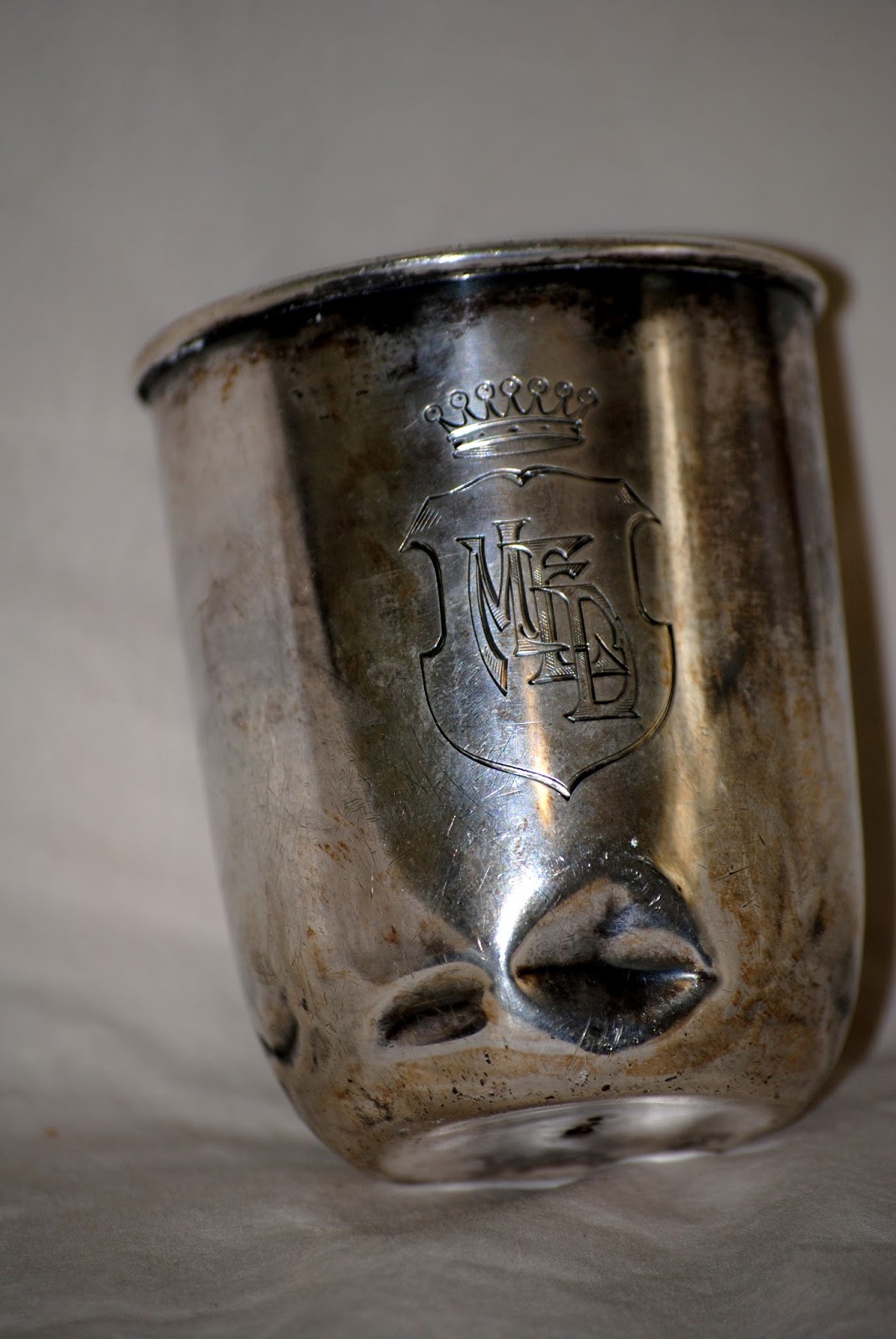
Family Silver

What remains of my family silver
Family Silver is a concept referring to the remains of what a family haves, in my case in my family we actually have family silver though very little remaining.

Two pieces have belonged to me since I have been a baby, a pitcher and a shot glass.   With my parents death what was left was divided between Nik, Beatrice and myself.

The family silver I have is:

  • Five Spoons from the 1880s
  • Two Forks from the 1890s
  • 4 shot glasses from the 1960s and 70s
  • A baptismal cup from 1929
  • A pitcher from before 1860
  • 12 knife rests from the 1960s


This is the baptismal cup for my mother Margarita Esther von Dellingshausen
I think this cup should go to my sister's first granddaughter


The single most important piece to me is this pitcher.  I was made in the mid 19th century and was originally a piece of von Grünewaldt silver.   In about 1864 the family home was broken into and all the family silver was stolen but the robber was seen by my great grandmother Ebba.   Her description helped the police find the robbers but all the silver other than this one piece were melted down.

At the end of World War 2 it was still in the possession of my great grandmother as she was transported by the Soviets to a labour camp in Siberia with her daughter Beate and granddaughter Sabine.   Ebba died on the way to the labour camp and Beate shortly after arriving.  Somehow Sabine managed to keep a hold of this pitcher through her 12 years in the labout camp.    She says it is because it was so tarnished and beat up that no one thought it was silver.   When she was released from the Soviet Union she managed to bring it out with her.

Sabine gave it to me for my baptism.

In 1994 our home in Vancouver was broken into and all CDs, thestereo equipment and some of Catherines jewelry had been stolen.  I thought this pitcher had been stolen as well because it was missing.   I told Sabine that I thought it had been stolen, she said that it would turn up.  Some months later I found it when I went to clean out behind the fridge.


In theory there are a couple of other pieces of silver I should have in my possession, a soup tureen, a couple of candlesticks and some more spoons.   I saw them once when I was nine years old and in Sweden.   Long story, they were in the hands of a distant Schulmann cousin and were supposed to come to me.   My father and this cousin had some issues with each other and my father wanted me to assert my right to the silver which made me unconfortable .  When years later I came into contact with this cousin via one of the Finish branch of Schulmanns the message that came back from him almost immediately was that his home had bee broken into the week before the silver had all been stolen.

Friday, November 22, 2013

The Beaverbrae II - the ship that brought many Baltic Germans to Canada

Growing as a Baltic German in Canada, most of the people I met that came over as immigrants did so on ship, the Beaverbrae.

The ship was initially known as the Huascaran by the Hamburg America Line.   She was intended to serve on their Mexico-Panama Canal-South American Service with her sister ship was Osorno and made a single voyage to the west coast of South America before being requisitioned by the Kreigsmarine.   The ship was launched on December 15th 1938 as a 10,480 gross ton freighter with a speed of 17 knots.  She was ready for service on April 27th 1939

During the war she served as a submarine depot at Trandheim in Norway.   and then taken over by the Canadian War Assets Corporation managed by Park Steamship Company

Muendels on the Beaverbrae in 1952 I think
After being captured by the Allies at the end of the war and came into to the possession of the War Assets Corporation.   In November 1945 she was handed over to Great Britain as part of the War Reparations.  Later in June 1947 she was allocated to Canada as part of this country's war reparations.  After arriving in Montreal she was purchased by Canadian Pacific on September 2 1947 and renamed the Beaverbrae II.   CP had a previous ship known as the Beaverbrae that had been sunk in March of 1941 by German Focke Wulf Condor bombers.

The Beaverbrae II  was refitted in Sorel Quebec into a cargo liner of 9,034 gross tons with space for 773 passengers, 74 in cabins and 699 in dorms.

The Commissioner of Immigration Arthur Jolliffe placed the Beaverbrae at the disposal of the Canadian Government and the Canadian Christian Council for the Resettlement of Refugees (CCCRR).  The ship sailed about every 28 days with 773 passengers. In its service to the CCCRR, the Beaverbrae completed 52 voyages carrying a total of 33,259 passengers from Bremen, Germany, Rotterdam, Holland and Antwerp, Belgium to Halifax, St John or Quebec City, Canada..

Her final trip carrying people to Canada left Bremen on July 28th 1954.

Both my parents and my aunt Nata Runge came over on the Beaverbrae.  My grandmother Maria von Fersen, her two young sons  and my cousin Charlie did not come on the Beaverbrae, but on the Arosa Kulm.   The first job both my parents had in Canada was on the Beaverbrae as translators, so they were hard working immigrants before they even got off of the ship at Quebec City.   They were both expected to do work on the ship to "pay" for their passage, this meant cleaning and cooking.

My father sailed on her in 1951 leaving Bremerhaven on August 22nd and arriving in Quebec City on September 3rd.  He spent the trip playing cards for money and winning.   My father would have made a good professional poker player if he had any real desire to play for money.

My mother sailed in August 1952 from Bremerhaven arriving in Quebec City on August 19th.  Her trip was a non-stop party for her.   As a 23 year old woman travelling on her own she spent most of the trip cavorting with the crew.

In Quebec City  my mother boarded a special immigrant train that took her, and many others to Winnipeg from where they traveled onto their final destinations by train.  My mother was headed to Penticton to work as a nanny and housemaid for the family of Dr Wickett.  Her first home in Canada was 689 Winnipeg Street in Penticton


Maria von Fersen's 1954 German Passport

Interesting is that in his passport her citizenship is listed as Deutshe and not  "Einem deutschen Staatsangehörigen gleichgestellt" which is that is was in her 1950 Deutshe Kennkarte and as my father had in his 1951 German Passport.

Her passport was issued on May 3 1954, about six and half weeks before she sailed for Canada


Nils and Lorenz were on her passport


Maria von Fersen's Canadian immigrant visa issued May 26th 1954 in Hanau

Maria von Fersen landed in Quebec on July 2nd 1954

Seems that in April and May of 1957 my grandmother was in eastern Canada and visited the US from there

So my grandmother arrived back in Vancouver October 2nd 1960 via air - I assume she was returning from Germany but  had no idea she had gone there in 1960


Early documents from my Grandmother Maria von Fersen 1947 to 1954

My grandmother Maria von Fersen was born in 1905 in Estonia when it was a territory of the Russian Empire.  She was barn as part of the Stackelberg family

The front over of her Deutsche Kennkarte dated from 1950 - this has to be her second one post war

The inside of Maria von Fersen's Deutsche Kennkarte issued January 6th 1950
Interesting is that the document lists where she was living on September 1st 1939
She, like my father is listed as "Einem deutschen Staatsangehörigen geleichgestelt" in the nationality portion of the document

Cover of Maria von Fersen's de-Nazification notice


On June 9th 1947 my grandmother was declared not to have been a Nazi under the March 5th 1946 law about  National Socialism and Militarism
Maria von Fersen's Passage Contract to Canada.   She sailed with her two sons and her grandson.
Total cost was $425 to sail on the the four of them on the Arosa Kulm.  They left Bremerhaven on June 22nd 1954 and arrived at Quebec City on July 2nd 1954.
You can see pictures of the Arosa Kulm from a summer 1956 sailing to Canada.  The Arosa Kulm seems to be much fancier ship than the Beaverbrae which brought the bulk of the Baltic Germans to Canada in the early 1950s

Friday, November 15, 2013

My parents first driver's licences issued in 1948 and 1951 respectively

My father Axel von Schulmann was issued this driver's licence before the create of the Federal Republic of Germany.  He was in the American occupation zone and therefore it is bi-lingual. 

His class 4 licence was issued September 9th 1948 at age 26.  He got a class 3 endorsement on March 23rd 1950
He brought this licence with him to Germany in 1975 and it was actually still valid and preferred by the company renting him a car.   Seems the wallet size plastic ones from Canada were not what the Germans knew what to do with in the 70s
My father worked on a farm after the war and had drive tractors and trucks for work from 1948 to 1951 when he left for Canada. 
This is my mother Lita von Schulmann's - you can see she is referred to as Baronesse on it.   It also has her Frankfurt address, Forsthaus 42

She got her class 4 licence on July 20th 1951 in Frankffurt at age 22.  Interestingly she had no restrictions.  In Canada she was not allowed to drive a standard because her left leg was lame.  I know she had few chances to practice driving because her skills were not great when she came to Canada.

My mother with her Model A in Vancouver in early 1953 - she crashed this car near Broadway and Fraser in early 1953.  A car was one of the first things my mother bought in Canada - for her it was freedom

My Parents Passports from 1951 and 1954

This is my father Axel von Schulmann's passport - note he is not called a German citizen, but "Einem deutschen Staatsangehörigen gleichgestellt" he is granted the equivalency of German citizenship

The passport was issued on August 4th 1951, which is weird give that on page 6 he has a stamp from Canadian Dept of National Health and Welfare dated August 1st 1951.
From this I know that he lived at Oberpolln Huse Nummer 28 in Pfrombach before emmigrating

The passport was only good for three year terms - he renewed it once on September 2nd 1956 in Vancouver

From this I can see my father landed in Quebec on September 3rd 1951.
He got his visa for Canada issued in Bremen on August 15th 1951
The August 1st date on the upper left page is odd

This is my mother's only German passport I know of.  Interestingly it has her as a German citizen.
My mother came to Canada on a a Nansen Passport sort of thing which she managed to get in 1950   This pre-dates the 1951 UN stateless person convention passports so she had something predating that document. I remember seeing it years ago but I have no idea where it is now.  It was grey 

My mother got this passport issued August 24th 1954 in Vancouver some months after she married my father.

Interesting, this passport has no Canadian visas of any sort.  Also interesting is that this passport was issued for five years.   My father's passport was only renewed for three years in 1956.

Friday, October 18, 2013

Initialzündung aus Moskau Was der Rubel-Kredit für den Assuan-Damm bedeutet

This is a November 1958 article for Die Zeit by my uncle Helmut von Schulmann about the Aswan Dam project in Egypt.  I am posting the text here so that I will have access to it in the future

Kairo, Anfang November

Das Projekt „Saad El Ali“ – Hochdamm – steht wieder auf der ägyptischen Tagesordnung, seit der Kreml einen Kredit von 400 Millionen Rubel (nominell ungefähr gleichviel D-Mark) für seine Durchführung zur Verfügung gestellt hat. Nachdem der ägyptische Wirtschaftsminister zu Beginn dieses Jahres das Projekt von der Prioritätsliste abgesetzt hatte, war vom Assuan-Hochdamm kaum mehr die Rede gewesen. Die Vorarbeiten, die Anlage von Zufahrtstraßen und der Bau von Arbeiterbaracken wurden jedoch im Hochdammgebiet südlich von Assuan mit bescheidenen Mitteln fortgesetzt. In unterrichteten Kreisen wußte man, daß Nasser die Absicht nie aufgegeben hat, alles zu tun, um das für die Gesamtwirtschaft des Landes überaus wichtige Vorhaben durchzuführen und daß er seinen Plan auch in den Gesprächen mit dem Sonderbevollmächtigten Chruschtschows, Mohiedinow, im September in Kairo behandelt hat.

ANZEIGE
Seit der Ablehnung der Finanzierung des Hochdammprojekts im Herbst 1956 durch die Amerikaner ist die ägyptische Regierung mit aller Energie an die beschleunigte Durchführung des industriellen Fünfjahresplanes gegangen; es gelang Kairo, in Sowjetrußland, der deutschen Sowjetzone, in Japan und auch in der Bundesrepublik langfristige Kredite zu erhalten.

Die Durchführung dieses und weiterer Pläne vermag aber das schwerste Problem Ägyptens – die bei ungefähr gleichbleibender Anbaufläche schnell wachsende Bevölkerungszahl – einer Lösung nicht näher zu bringen; vielleicht ist sogar das Gegenteil der Fall: jede zusätzliche Beschäftigung bringt einen verstärkten Bedarf an Nahrungsmitteln mit sich, der schon heute aus der Eigenerzeugung nicht gedeckt werden kann.

Ägypten lebt vom Nil, dessen Wasserstand nicht nur jährlichen, sondern auch saisonalen Schwankungen unterworfen ist. Während der Monate Januar bis Juli führt der Nil zuwenig Wasser, und die Versorgung der Landwirtschaft kann in dieser Zeit nur durch die Ansammlung des Wassers in einer Anzahl von Stauseen, vor allem in Assuan, sichergestellt werden. Nach den Regenfällen in Äthiopien im März, April und Mai erreicht die Nilflut im Juli Ägypten und läßt den Strom ansteigen, so daß etwa 40 v. H. des wertvollen Wassers ungenutzt ins Meer abfließen. Durch den Hochdamm sollen ein Reservoir von 130 Milliarden Kubikmeter Wasser geschaffen und mit dessen Manipulierung eine regelmäßige und reichliche Versorgung des Landes gewährleistet werden. Flut und Ebbe würden dadurch ausgeschaltet und die Kultivierung von etwa 800 000 ha Neuland ermöglicht. Von besonderer Bedeutung ist die Möglichkeit einer Vergrößerung der Anbaufläche für Reis, dessen Ernte in diesem Jahr durch Wassermangel beträchtlich zu leiden hatte. Durch die Realisierung des Hochdamm-Projektes würde die Ackerfläche um 30 v. H. erweitert werden, zudem ein wirksamer Schutz gegen Überschwemmungen geschaffen. Diese fügen dem Land jährlich in die Millionen gehende Verluste zu. Schließlich würden sich die Entwässerungsbedingungen im Delta durch die Stabilisierung des Grundwasserspiegels erheblich verbessern. Die Nachteile (hohe Verdunstungsverluste im neuen Stausee und der Verlust der vom Nil mitgeführten Dungstoffe – „Nilschlamm“ –, die sich am Boden des Stausees ablagern würden) sind im Vergleich zu den großen Vorteilen eher geringfügig.

Der Stausee würde 110 Meter über dem Flußbett liegen. Dadurch könnten große Energiemengen ausgenutzt werden. Das vorgesehene Kraftwerk soll eine Kapazität von sieben bis zehn Milliarden Kilowatt-Stunden im Jahr erhalten, deren Gestehungspreis auf 5 Pfennig per kWh geschätzt wird. Der elektrische Strom soll durch Überlandleitungen in die Industriegebiete bis hinauf nach Kairo geleitet werden, wo eine große Anzahl neuer Industrien dadurch mit billiger Energie versorgt würde.

An der Ausarbeitung des Projekts haben sich viele ausländische Firmen, darunter in erster Linie deutsche, beteiligt. Erste Sachverständige der Welt haben sich mit dem Problem eingehend befaßt. Der Anfang 1955 aufgestellte Plan setzt die Gesamtkosten für den Bau des Damms – einschließlich des Kraftwerkes, der Überlandleitungen und der Urbarmachung von 0,8 Mill. Hektar Land – mit rund 240 Mill. Pfund an, von denen etwa 45 v. H. in ausländischen Devisen aufzubringen wären. Eine Schwierigkeit bei der Durchführung des Projekts liegt. auf politischem Gebiet.

Der Sudan und die anderen Anliegerstaaten des Nils können dabei nicht übergangen werden, und ohne eine Einigung mit ihnen dürfte das Projekt nicht durchführbar sein. Der Sudan hat den Wasserverteilungsvertrag mit Ägypten vom Jahre 1929 für ungültig erklärt und beabsichtigt – wie auch Äthiopien –, auf seinem Gebiet Staudämme zu errichten. Es kommt noch hinzu, daß die Hochstauung in Assuan weite Gebiete des Sudan, darunter auch die Stadt Wadi Haifa, unter Wasser setzen würde. Verhandlungen über die von Ägypten zu zahlende Entschädigung haben bisher zu keinen Ergebnissen geführt.

In diese Situation platzte die Bombe des russischen Anleiheangebots, das in der Linie des Sowjetvorstoßes im Mittleren Osten liegt und sich an den zu Beginn dieses Jahres gewährten Industrialisierungskredit von 700 Mill. Rubel (zu 2,5 v. H. auf zwölf Jahre) anschließt. Vorläufigen Mitteilungen zufolge wird der Assuan-Kredit von 400 Mill. Rubel (37,5 Mill. Pfund) in Form von Lieferungen für die Durchführung der ersten Etappe des Hochdammplans gewährt, die in vier Jahren beendet sein soll. Die Rückzahlung des 2,5prozentigen Kredits soll nach sechs Jahren beginnen und in zwölf Jahren abgeschlossen werden. Nach deutschen Berechnungen würden die Arbeiten in den ersten sechs Jahren 147 Millionen Pfund kosten, wobei erst im siebenten Jahr mit einer Regierungseinnahme von 2,5 Millionen Pfund gerechnet wird. Die Rückzahlungsbedingungen für die Sowjetanleihe sehen also eine verhältnismäßig kurze Zeit vor. Falls das Vorhaben programmgemäß durchgeführt wird, ist mit einer Steigerung des Volkseinkommens um rund 250 Mill. Pfund im Jahr zu rechnen, wodurch – über Steuern – eine normale Amortisierung der Anlagekosten gewährleistet sein würde.

Wie in Kairo zu hören ist, sollen die Arbeiten mit Hilfe der besten Experten aus der ganzen Welt durchgeführt werden. Von russischer Seite ist angekündigt worden, daß die Sowjetunion eine größere Anzahl von Technikern und Sachverständigen nach Ägypten delegieren will.

Helmut von Schulmann

Friday, August 30, 2013

An Interview with Maria von Fersen (nee Stackelberg) about her life story

In 1973 my grandmother, Maria von Fersen nee von Stackelberg, was interviewed about her life story as an immigrant woman to Canada for the Vancouver Project. I found this interview by accident on day in the BC Archives in 1988 as she was in the hospital in Vancouver.


Granny, as we called her, was born into the Baltic German nobility in 1905 and had a priviledged life till the Russian revolution.   She lived in the interwar Estonian republic.   From her first marriage to Patrick von Dellingshausen she had two daughters, my mother Lita and my aunt Nata.   She and Patrick divorced in 1941 and both married again almost immediately.

She was married to Olaf von Fersen for seven years and had two sons from that marriage, Nils and Lorenz.

In 1952 my mother came to Canada as a happy go lucky 23 year old wanting to see the world.  Within a few short years Maria saw a better for her young sons in Canada than bombed out West Germany and decided she would emigrate to join her youngest daughter in Vancouver.

Maria arrived in Canada in 1954 at age 49 as a single mother with few job skills.   She ended up working as a cleaning lady at first in Vancouver.  She eventually worked at St Paul's hospital as a aid till she turned 65 in early 1970.   Since she spoke fluent French, part of a good pre World War I noble education, she would be the translator for Quebecois that came into the hospital.

After retiring from the hospital she continued to work as a live-in caretaker till about 1977.

All four of her children ended up in Vancouver which meant she had the core of her family around her.  Growing up my family was defined first and foremost as the children and grandchildren of Maria von Fersen.

I feel lucky that I got to know her as an adult without my parents around.

Starting when I was 16 I would go to the Vancouver Symphony with her a couple of times per year.  This started because she thought I should understand what classical music was all about. I suspect she was European enough to feel that I was becoming too much of an uncultured Canadian.

Once I was at University when I was coming over to Vancouver from Victoria for a day or two I would try to make it for a Tuesday.  This was the day each week my grandmother and Lorenz had lunch at her place and I would join them.   I had a chance through those lunches and the time I would spend with her in the afternoon afterwards to get to know her as an adult.

I remember the moment in 1988 in the BC Archives when I stumbled on her name in the card catalog.  Maria von Fersen is a unique name so I was certain this was my grandmother but because there was a restriction on the file it did not tell me this was.  It took me a second daytime visit to get access to the file which I then found out was this interview.

I found this interview as she was in her last days.  I got a copy of the interview from the BC Archives 25 years ago, but it took my till now to finally get it into a format to easily share it online.

The name Granny lives on in the family in my sister how has chosen that has her name for her grandchildren.

Wednesday, December 19, 2012

Some pics of Xmas in the late 90s and 2000

Our tree in Lillooet in 1998


Getting the tree in 1999 with Ben and Daniel
Our overloaded car - this is at the top of the Duffey Lake Road
part of the 1999 tree


1997 Pavilion Xmas Party
Daniel with Santa in Pavilion 1997
Ben's first time with Santa - Pavilion 1997
Daniel with the Baltic Santa 1999
Ben 2000 
Kids waiting for the Baltic Santa 2000
Daniel with Santa in Lillooet 1997

Daniel with Santa in Lillooet 1998


Xmas dinner 2000 in Lillooet

Xmas dinner in Tsawwassen 1999