Showing posts with label Aboriginal. Show all posts

Tuesday, July 09, 2013

Language Matters - the importance of aboriginal languages

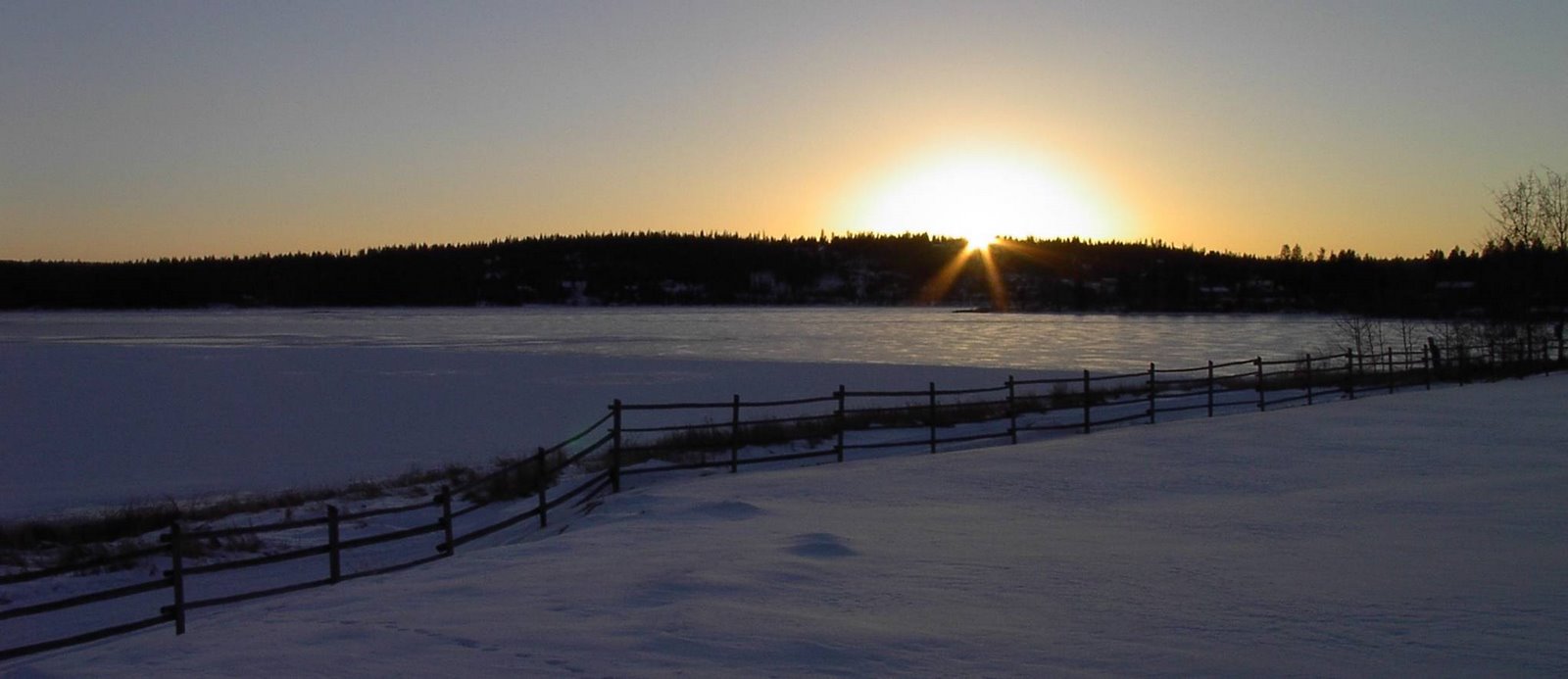
The Fraser looking towards X'axlip in the winter
Same place but in the early fall
An old friend from my days of working with the Ts'kw'aylacw First Nation is staying with us for a couple of weeks while he is doing some course work for his Masters degree.   Bucky is involved with reviving the St'at'imc language and in talking with him I am reminded how vitally important the language is to the survival of the culture.

I love the land along the Fraser from Lytton through to near Williams Lake.  It is a landscape that speaks to on a very personal level but it is also a place that neither English or German describe well.  Look at the two pictures of this canyon on the Fraser and think about how short we are of words to name the features we can see.

Language matters because all languages are strongly tied to the time and place they come from.   Languages do evolve over time but always retain their core connection to the culture and place they come out of.  Protecting the land or the culture becomes very hard if the very words and phrases to describe it are lost.

English is a language that evolved to describe a cool, damp, and green island off of the coast of Europe.   In English there is no end of ways to talk about damp and rainy weather.   There are no end of words for small brooks or creeks, hills have a mass of words.  At the same time there is only one word for mountain, one word for a river, and one word for lake.   Green can be named in numerous ways but brown has few words and most of those recent created ones like "coffee" or "chocolate".

Aboriginal people are working hard to protect the lands they have inhabited since the start of human history.   In working for First Nations I could tell that there was something else going on about why the land mattered and that this is not simply a real estate transaction but few people could still express what the land means to them.

In St'at'imc, the word for the people (Ășcwalmicw) and the land (tmicw).    Who the St'at'imc are as a people and culture is tied to the land in a very intimate way but they can not describe this in English.   I have seen the frustration in leaders who know there is something more but they can not say what it is.   Working in English on aboriginal title and rights issues leads to frustration on all sides.

I remember living at Pavilion Lake and having this amazing changing landscape in front of my doorstep.  In the winter when the lake froze we suddenly had all this landscape to walk on.   We set up tables on it, we fished in the lake through holes in the ice, I took Laika for long walks on the ice.   What I could not do was easily describe this place.

View from our front door on Pavilion Lake
Ice is such a limited word.   Ice comes in so many forms on the lake.  Early in the season it is thin and growing to the middle from the edges.  It is relatively smooth at this point.  Once we could walk on it became something different.  It was not smooth and flat but bumpy and lumpy.  Snow that fell would be compacted on it.   The pressure of the ice would cause cracks and sections to rise up a bit.   It was nothing like an ice rink.    Late in the season the ice would melt in reverse from how it froze, the edges would come free first.   The ice would also completely change structure to something I have heard called rotten ice but it does not really describe what it was like.   Every day the ice on the lake was different and we only had one word to describe it.

The most amazing thing that would happen on the lake in the winter is when it would go down to -30.   At this point the ice would have cracks suddenly appear.   At night we would hear loud travelling booming sounds under the ice.   I have no easy way in English to describe this like.  It is as if rain had to cover mist and torrential downpour at the same time.

Ashcroft, a small town in a large landscape
I think it is important for everyone in BC to see a strong revival of the aboriginal languages so that we can find a better connection to the land.  If we are to do more than just exist day to day we need to be able to speak about what is around us.  We need to be able to name the places in an easy and specific way.   English as a global language is never going to make itself be BC specific but we do not need to have it become specific to BC when we have all these aboriginal languages that developed in this landscape.

Not being able to speak of the places we live in means we alienate ourselves from the world around us.  This is not healthy.

Farwell canyon


Friday, January 18, 2008

Gordon Gibson on the Williams Case

Laying claim to British Columbia
The William decision has implications for provincial jurisdiction, private property
GORDON GIBSON

ggibson@bc-home.com

January 17, 2008

http://www.theglobeandmail.com/servlet/story/LAC.20080117.COTREATY17/TPStory/TPComment/BritishColumbia/

The B.C. Supreme Court's William decision on Indian rights and title is the most important case since Delgamuukw some 10 years ago. It could lead to a constitutional crisis. One issue is the suggested federalization of a very large fraction of B.C. Crown lands. The other is a renewed suggestion of Indian title over most private property in the province. Deeply worried governments are saying nothing.

The case is named after Chief Roger William of the Xeni Gwet'in First Nation claiming ownership of more than 4,000 square kilometres of central B.C. It spanned five years, 339 court days, cost the taxpayers $30-million and ... amazingly, made no specific title award.

But, as the courts have been doing lately, the decision put a heavy thumb on the Indian side of the bargaining scales.

While the Supreme Court of Canada in Delgamuukw said "aboriginal title" may exist and set out the characteristics of such title and broad rules for its establishment, not one square inch had been so identified pre-William.

Mr. Justice David Vickers in William gave an opinion - not a ruling for technical reasons, but a very informed opinion - that the aboriginal title of this one small group of about 400 people spans about 2,000 square kilometres, a bit smaller than Metro Vancouver or about half of Greater Toronto. (There are 200 other bands in British Columbia, all with large claimed territories.
)

Aboriginal title applies to lands exclusively occupied in 1846 and not surrendered since then. "Occupation" is to be generously construed: one kilometre on each side of a river, for example, and Judge Vickers appears to give similar respect to "foot trails," etc. If the Judge Vickers approach is sustained on appeal, B.C. Indians have a reasonable expectation of court-ordered ownership of a large fraction of the province.

Perhaps more importantly, the court stated that whatever is found to be Indian title land is subject to federal law - not provincial. More than 100 per cent (due to overlaps) of B.C. is claimed as Indian land.

Of course, the forests, waters and mines would not disappear. But there would be new owners, exempt from taxation, and under Ottawa's control. As the judge says in his summary: "Aboriginal title land is not 'Crown land' as defined by provincial forestry legislation ... The jurisdiction to legislate with respect to Aboriginal title land lies with the federal government pursuant to s. 91(24) of the Constitution Act ..."

To explain, Section 91(24) is that explicitly racist section of the Constitution that gives Ottawa power over "Indians, and lands reserved for the Indians." Should you think "racist" too strong, I refer you to Supreme Court of Canada Justice Ian Binnie, who said of the section, "But it is race based authorization. That is all it is."

What this means, if sustained, is that Ottawa, not Victoria, would regulate much of B.C., including the more habitable parts. Even Ottawa's powers might be severely limited by the Supreme Court of Canada's "justification" test that is required for any limitation of aboriginal rights. Forest companies, mining companies, ranchers, B.C. Hydro, road builders, policemen, municipal governments and others, take note and consider your title and permits. To call this a constitutional bombshell is an understatement, unless one has nuclear in mind.

Judge Vickers then says of private lands in the area: "The Province has no jurisdiction to extinguish Aboriginal title and such title has not been extinguished by the conveyance of fee simple title." ("Fee simple" is what you have, or thought you had, if you own a house.) This calls into question any property subject to Indian title and not originally conveyed by way of pre-Confederation or federal Crown grant. This would draw Metro Vancouver into the net.

Of course all this is not new. The court said as much in Delgamuukw, but the language was opaque and the issue has been hidden. Ten years later Judge Vickers resurrects it with devastating clarity.

It is hard to think of anything more fundamental in the law, or more explosive politically, than private property. Indeed, treaty negotiations have always presumed that private lands are not in play. Not true.

Premier Gordon Campbell has been seeking a "new relationship" with the province's aboriginal people, but maybe not this one. The Premier's initial reaction to the decision was for a four-month cooling off period and talks with Mr. William, but both the federal and provincial governments have now filed notices of appeal.

This will be as disruptive to the treaty process as was Delgamuukw 10 years ago. A court has suggested a major change in the balance of power so, for the moment, confusion reigns. From the Indian side of the table, why bargain about land if you can get the best parts through the courts?

Ultimately this will end up in the Supreme Court of Canada. It is a powerful, careful judgment, not to be ignored. Under our Constitution the Supremes can do anything they want in matters Indian. They make the law. So they could find B.C. will not be federalized after all, who knows? However, the private lands part of Judge Vickers's decision will be harder to change as it directly flows from a previous Supreme Court judgment.

Ultimately the solution could be a constitutional amendment for British Columbia to clarify things. Such a constitutional amendment would likely pass since provincial jurisdiction and private property are basics of Canada.

The Constitution is meant to reflect our core values - and one way or another that will be achieved.

Sunday, November 25, 2007

Recent Aboriginal Title Court Decision in BC

I am going to write an analysis of the Tsilhqot'in ruling from last week in the next day or two. Many cases have been called landmark, but this one has some amazing new directions that the judge has accepted. These are issues that the First Nations have been raising for years and never managed to get the courts to deal with.

For the moment, here is something from the Sun.

________________________________________________


B.C., first nation to talk outside courts
Premier and native band leader agree to groundbreaking land negotiations following Supreme Court ruling

Jonathan Fowlie
Vancouver Sun

Saturday, November 24, 2007
http://www.canada.com/vancouversun/news/westcoastnews/story.html?id=333c6d7a-e26d-4fb6-a552-0ecd2ba0ba4a

VICTORIA - Premier Gordon Campbell and the Tsilhqot'in native band have taken the first major recommendation from this week's landmark B.C. Supreme Court ruling and agreed to begin negotiations outside the courtroom.

Chief Roger William said that in a half-hour meeting with Campbell on Thursday -- about 24 hours after the release of the ruling -- both sides agreed not to appeal for at least four months.

"It gives time for everyone to go through the decision and it also gives us time to put an agenda in place and start working on it," William said on Friday.

"Four months is going to give us enough time to test the waters -- for them and for us," he said.

On Wednesday, B.C. Supreme Court Justice David Vickers released a 473-page ruling that consisted mostly of opinion. In that opinion, he said the Tsilhqot'in had proven aboriginal title over about 2,000 square kilometres of land in B.C.'s Interior, though he could not give it to them because their request included land not covered by that title.

In the end, Justice Vickers strongly urged both parties to negotiate a solution outside the courts.

On Friday, William said he approaches that process with optimism for the fate of his people.

At the same time, however, many of B.C.'s other first nations are looking at the ruling as a way to guide the future of their own negotiations, and possibly their own litigation.

Grand Chief Ed John of the First Nations Summit said all of B.C.'s chiefs had already been invited to a four-day meeting in North Vancouver this coming week, and that the Vickers ruling will be dominant element of those discussions.

"We'll sit down and talk about where we are right now and the dynamics of where we need to go in the future," he said, adding the chiefs will also look at the Tsawwassen and Maa-nulth treaties that have been introduced into the legislature this session.

John was loath to predict the outcome of that four-day meeting, but did say that things need to change.

"The problem we run into is the governments refuse to acknowledge what the courts have said and use that as a foundation for negotiations,
" he said.

"We're going to see more litigation," he added.

"There are 40 more court cases in the works right now, and there may be even more after next week."

Chief Stewart Phillip, president of the Union of B.C. Indian Chiefs, went further, saying the focus at the meeting will be to "blast the governments out of their entrenched positions of denial and non-recognition."

"I think you can look forward to a definite mobilization," he said. "There's no question this decision will reverberate through the treaty process.

"In a sense the sun has finally broken through the clouds."

In an interview on Thursday, Minister of Aboriginal Relations and Reconciliation Mike de Jong confirmed the government had met with William, but would not reveal any details about what took place.

When asked about the meeting of aboriginal leaders this week, and what the ruling means for the future of the treaty process, he was quick to say it will be a long time before the significance of the ruling is clear.

"What did they get? They got an opinion," he said, pointing out the ruling mostly consisted of non-binding opinion.

"I think we've demonstrated a willingness to adjust to changing circumstance, but I'm not going to predict to you today what the effect of a single opinion from a judge, however lengthy, is going to have or how we are going to respond," he said.

"I do know we are going to keep talking, I do know we are going to keep discussing."

In Ottawa, Minister of Indian Affairs and Northern Development Chuck Strahl was equally reserved, with his office releasing the exact same statement on the matter that it did on Wednesday.

"Our government will review this decision and carefully assess its implications and determine what our next steps might be," read the statement.

"We do agree that parties involved in such claims should use discussion and negotiation instead of litigation to resolve these outstanding issues of aboriginal rights and title."

Despite those tepid responses, William said he remains optimistic.

"I believe the premier when he says he respects the decision of first nations. He's going to look at working with us," he said.

"I feel the decision that came down is a tool we can use if the governments are not willing to give what we want," he added.

"We have a tool to force their hands."

And John?

On Thursday, he said that while the effect of the ruling is not yet clear, he has no doubt it will be significant.

"It is an important moment for us," he said.

"We're at a crossroads. Negotiations are at a crossroads in this province right now," he added.

"The government of Canada and the government of B.C. have to change their approach."

Monday, October 15, 2007

Kim Baird speaking in the legislature on Oct 15th 2007

Address from the Bar of the House

K. Baird: Mr. Speaker, hon. Members, ladies and gentlemen, I'm very honoured to be addressing the Legislature today and further honoured to represent my community. The fact that so many members of my community are here to support me gives me strength and holds me up.

For the Tsawwassen people this is a time of great hope and optimism, a challenging yet exciting time. It is a time for revival and renewal. It is a time when we will take back our rightful place as a community equal to others through our treaty.

I say take back our rightful place, because we have a long and proud history that predates the birth of this province. For thousands of years we used and occupied a large territory that was abundant in fish, shellfish, wildlife and other resources.
The Tsawwassen treaty means many things to many people. In my view, one of the important things this treaty achieves is the new relationship between Tsawwassen, British Columbia and Canada. It achieves reconciliation, and I mean true reconciliation.

To me true reconciliation signifies real action and tangible change. True reconciliation is the product of this treaty. It proves to the world that reasonable people can sit down and settle historical wrongs. It proves that a modern society can correct the mistakes of the past while providing for differences in values and cultures. As first nations, as British Columbians and Canadians, we should all be very proud.

My presence here today is symbolic of true reconciliation. Our reconciliation was born of hard work and hard-fought compromises, so very painful to my community.

I also have reflected on other recent events that I view as very important steps towards reconciliation. The Hon. Steven Point's recent appointment as British Columbia's 28th Lieutenant-Governor is one of these recent events, a significant step in our history. Even the covering up of the murals offensive to so many is important, because in my view, true reconciliation is a culmination of steps where we try our best to better understand and accommodate each other. Though we try our best, accommodation comes through change that can often be painful and rocky.

This past July, after 14 years at the negotiation table, we ratified our treaty. After an enormous information campaign mounted by our council, staff and supportive community members and through careful review, members of my community ratified our treaty by a resounding 70 percent.

That is why I am here today.

The treaty will be debated here in this Legislature before travelling to Parliament Hill in Ottawa for final debate and, hopefully, formal ratification.

There were times I thought this day would never come. I'm so relieved to be able to stand before you and to launch a debate that will decide the fate of the future for all of us. Our people have waited for well over 100 years for this moment.

I like to think that our ancestors would be proud. I also like to think that some of our aboriginal leaders who are no longer with us and who devoted their whole lives to the notion of treaty-making, which has afforded me the opportunity to negotiate our treaty, would celebrate our achievement too - or in recent times, those members who have recently left us and who provided such strong support for the idea of true reconciliation.

I'm so grateful to trail-blazers who have taken this journey before us, such as the Nisga'a.

I must pause and reflect a little bit on our journey to today. In our language, Halq'em-ylem, the word "Tsawwassen" is translated into English as "land facing the sea." It also provides an accurate description of our home, our current reserve and most of our treaty lands being located in what is now known as Roberts Bank in Delta on the southern Strait of Georgia, near the Canada-U.S. border.

We were accomplished fishers. Salmon and sturgeon were mainstays of our traditional diet. This is still the case today. In small skiffs with powerful motors, also known a mosquito fleet, we fish for salmon, oolichan and crab, primarily. In fact, because of urbanization of our territory, fish is one of the only renewable resources we have access to and, as such, is of vital importance to our community.

Fish provides for cultural and social processes that are very important for our identity. I should say that I've read many draft treaty chapters in between sets while fishing in my own little gill-netter as well.

Our traditional territory was bordered on the northeast by the watersheds that feed into Pitt Lake down Pitt River to Pitt Meadows, where they empty into the Fraser River. It includes Burns Bog and part of New Westminster following the outflow of the river just south of Sea Island. From Sea Island it cuts across the strait to Galiano Island and includes all of Saltspring, Pender and Saturna islands. From there, the territory continues northeast to include the Point Roberts peninsula and the watersheds of the Serpentine and Nicomekl rivers. We have never surrendered this territory of ours.

Our ancestors were also skilled hunters. Waterfowl, ducks, mallards and loons as well as sea mammals such as porpoises, seals and sea lions formed part of their diet. The tidal flats at Westham Island and Boundary Bay were favoured duck-hunting areas. Today our hunters get most of our ducks fronting our existing reserve. Elk, deer, black bear and beaver were hunted in season, supplementing the regular diet of fish.

Ancient Tsawwassen people greatly relied on western red and yellow cedar, which provided homes, firewood, food, tools for carving and cooking, great ocean-going canoes, clothing and ceremonial gear. Food was abundant. A trade and barter system was in place. Specialized services were also exchanged.

We also had extensive practices and ceremonies that dealt with governance functions in our longhouse. Our longhouse systems also ensured the redistribution of wealth to make certain our people would survive. Experts are still learning how complex these practices were and are. This is a far cry from the portrayal of aboriginal people as savages.

I don't want to dwell on the impacts of European contact too much, but there are facts we need to consider. We can't underestimate the impact European contact has had on our communities. Over the past century our lives were much diminished by newcomers, who first took our labours for furs and fish but then later took our lands and resources and considered us a nuisance when our labour was no longer desired.

Residential schools forever changed the face of our communities, due to the apprehension of our children and discouragement of our culture and language. These impacts will face us for many more generations, and as a mother of two small children, I cannot tell you how distressed I feel when I think of what has happened to our ancestors.

Sadly, either these tools or similar tools of colonialism were used throughout the world at this unfortunate time in world history. More specific to us, tools of land title and other rights of newcomers were mapped over our territories, effectively erasing our presence and marginalizing us to the fringes of our territory and broader society.

In more recent times, these tools have evolved to land-use designations, official community plans and livable regions strategies.

Again, other people mapped over our territories, without our input, all the while with unextinguished aboriginal title that still underlies our territory. Does this sound extreme? For sure, land use and development issues are key issues in our treaty and in the lower mainland as well. In fact, this is the crux of controversy because of the importance of these issues.

Consider the clause in our treaty that stipulates the transfer of 207 hectares to us from the agricultural land reserve. Some of you may have heard of this. In the countdown to the final agreement, we made it clear we needed those lands in order to live and grow, to set up businesses and build houses. No other aspect of our treaty resulted in as much controversy - so many headlines. Some critics - including columnists, environmentalists and politicians - are trying to block our treaty because of the agricultural land reserve issue.

Critics choose to ignore Tsawwassen's history of being victims of industrial and urban development to the benefit of everyone but us. The naysayers do not seem to care that they are calling for the continued exclusion of Tsawwassen from opportunities everyone else has enjoyed. "So what of Tsawwassen First Nations legitimate economic needs? So what of Tsawwassen First Nations land base needs? Let's just continue to ignore Tsawwassen First Nations needs."

I try not to become too disheartened, and I hope the members of my community take the same approach, because the facts speak for themselves. Today we have a tiny postage stamp of a reserve, a small fraction of a percentage of our traditional territory fronting a dead body of water trapped between two massive industrial operations. Our land and aquatic ecosystems have been fouled beyond human comprehension.

The ferry causeway with its millions of cars and trucks dissects our reserve to the south. Deltaport, with its 24-7 coal and container traffic, coats our houses with diesel particulate. Trucks and trains keep us awake at night. Consider, too, the bulldozing of a Tsawwassen longhouse for the construction of the ferry terminal causeway. No consultation. These industrial operations that include a manmade island terminal and a causeway linking them to the mainland have virtually destroyed our beaches, at least our ability to use them as we had once traditionally.

The ALR issue is just one of the compromises required for the conclusion of this treaty. Although this is one of the more publicly controversial aspects of it, make no mistake that my community has had to make a number of compromises too. I've highlighted this issue because I was worried it would overtake our collective mutual objective of reconciling aboriginal rights and title with the Crown.

I think I can say on my and my community's behalf that true reconciliation requires this treaty receive broad support. I want our treaty to have the support of as many parties and individuals as possible. To have it become a political football due to various specific public policy issues, in my view, sullies the whole point of true reconciliation.

Compromises are indeed difficult but also very necessary. I think that there are many other reasons why this treaty represents true reconciliation. I'm very excited by the fact that the Tsawwassen people will no longer be tethered to the archaic Indian Act, an act which has failed all of us.

We no longer have to have our aspirations subject to a legion of bureaucrats purporting to have our best interests at heart. True reconciliation as set out in the Tsawwassen treaty from this day forward will bring the end of that paternalistic act. Today true reconciliation also means access to financial resources and economic opportunities which will be used for economic development and infrastructure development.

True reconciliation will also provide services and programs to Tsawwassen members. While my community has endorsed our treaty, we still worry about our future. We have much work to do to implement our treaty and to undo the legacy of oppression. In the homes of our reserve you can feel both a sense of excitement and a sense of apprehension. The real work begins now. We must put our mind to developing our governance structures and institutions. Being ready for self-governance will require much effort by all of my members.

The treaty is a legal document, of course � a framework that ensures we can enter the economic and political mainstream of Canada. Now as equals, we enter the economic, political and social mainstream with all the rights and all the responsibilities. It also enables many new things. Our new relationship, such as within the membership of the GVRD, now known as Metro Vancouver, is a historic feat in itself. Today we are on the cutting edge of true reconciliation.

Our treaty is the right fit for our nation. More land, cash and resources provide us the opportunity to create a healthy and viable community, free from the constraints of the Indian Act. We now have the tools to operate as a self-governing nation for the first time in 131 years, since the first Indian Act was introduced.

The Tsawwassen treaty, clause by clause, emphasizes self-reliance, personal responsibility and modern education. It allows us to pursue meaningful employment from the resources of our territory for our own people. In other words, a quality of life comparable to other British Columbians.

To everyone, it provides economic and legal certainty and gives us a fighting chance to establish legitimate economic independence, to prosper in common with our non-aboriginal neighbours in a new and proud Canada.

In closing, I want to share this thought with you. I am often asked whether it has been worth it - all the years at the negotiation table and the endless meetings under a seemingly endless series of new governments, ministers and officials, so many with new protocols and new directives that often contradicted earlier ones. Far too often we had to start over in the face of these realities.

I have been very fortunate to have dedicated and loyal Tsawwassen members by my side for the negotiations. They're here on the floor with me today. They have also persevered through the ups and downs.

No one was more surprised than I was when we did conclude a treaty. These negotiations are complex. At times the gulf between our respective communities seemed insurmountable. Even though we completed our treaty, there are still parts of it that I find offensive, but in answer to whether it was worth it? Yes - a resounding yes.

When I began this process I was a young woman, 20 years old. Now I am what I like to think of as a youngish 37. Today I have two girls, aged ten months and four. I am confident that they will study, work and live in a new and different world defined by hope and fuelled by optimism, while being proud of their heritage.

I have to add that I am also glad that in the future, when my girls visit this building, they will not feel embarrassed by how their ancestors are portrayed on those murals.

The future is very bright for my children and all the children for my community, if the treaty is signed by the three parties. I hope their world will be so much better than the one their ancestors faced for too long.

We are decolonizing through accommodation of our differences, not assimilation. That, Mr. Speaker, I trust you'll agree, is the ultimate benefit of true reconciliation. [Applause.]
Wednesday, April 04, 2007

BC Treaty Process

With the defeat of the Lhiedli Tenneh final agreement, this once again calls in question the approach the Crown is taking to Treaty making in BC.

  • Sechelt voted down their Agreement in Principle
  • Ts'kw'ayalxw voted to leave the process before an AIP because the community could not see a settlement meeting their needs
  • Snuneymuxw First Nation did not ratify their AIP
  • Nuu-Chah-Nulth did not ratify their AIP

There are many other tables spinning their wheels because everyone involved knows that the community will vote down the settlement.

The process has some major flaws, in part I would argue that the First Nations made a major error in not coming to the table as a single group to negotiate an umbrella framework for what a Treaty will look like. With so many different negotiations, effectively the government can dictate the terms of the Treaty. At best the negotiations are about ow to arrange the deck chairs and not about the direction the ship is going.