
Wednesday, February 08, 2023


Friday, September 09, 2022
The Crown and I
The passing of Canada’s monarch has raised many thoughts and feelings within me. The personal embodiment of the Crown, the Crown any of us in Canada have ever really known, died but the Crown endures and instantly is embodied in our new King. And he is our King much more so than the King.
Canada is a constitutional monarchy where the monarch is not
here very often and it really costs us nothing which that means that we as a
nation are generally agnostics when it comes to the underpinnings of our system
of governance, the Crown. I reflect on all the ways the Crown is still
part of our lives and am slightly surprised at how all pervasive it is. There is nothing new to me, I just never
thought about all the aspects at once.
I work as a civil servant which means I work for the
Crown. This really has always been an
abstract thing for me, the legal construct we have to ensure we have a
government. The Crown has evolved over
the ages as the way for us to name the source of power for government. I work next door to what was the Queen’s Printer
and is now the King’s Printer. The human
aspects of the Crown have intersected with the governance aspects in ways like
this because of the passing of Canada’s Queen.
There is something absurd about the very idea of the Crown
but having the Crown means we have a monarch and there is always a human being
that embodies it. It is only within a
constitutional monarchy that the underpinnings of governance are given real human
form that is truly apolitical. This
matters and more than people think it does.
Constitutional monarchies, with all their preposterous traditions,
are oddly the most stable and consistent form of government we humans have come
up with. It was the established
constitutional monarchies of the 30s that resisted fascism and totalitarianism.
George Orwell made this observation at
the time, and I always thought it was purely coincidental but as I reflect on
this as King Charles has ascended to the throne, I think there is a lot more
truth to this than I ever thought before.
This change in the Crown will be more noticeable than it
might have been because the Crown has a gender. We have lived in a country where for the
last 70 years the ultimate fount of governance was female in form and now it
will be male. Most countries are “it”s
but through the personal embodiment of the state in the monarch our country has
a human gender. I have to wonder if
part of reason constitutional monarchies seem to be immune to extremism is
because the state is not a genderless object to be controlled by one political
faction or another but has a tangible human component that remains above politics?
The Windsors are a family of privileged people who have many
foibles. We have a whole celebrity
culture built around them. It is this flawed
humanity that has been why many of us in Canada have this agnostic feeling
about the monarchy. In the 90s I lived
in the UK and the monarchy was much present than I had ever experienced in
Canada. My uncle had had a much more personal
connection to the family than people in Canada ever have, he tried to get John
Turner and Princess Margret together. I
reflect back on our conversations about the institution, and I can see he had a
wisdom about the humanity of the people who are quite literally stuck in the
system.
Should we judge our recent Queen by the funny Paddington
video she made this year, or should we judge her as the person that sacrificed her
life to allow us in all her realms to have stable governments? And anyone that does not believe she sacrificed
her chance to have a personal life does not understand what she did for 70
years. King Charles made mistakes as a
human being in his life, but we should not judge him on any of that and should
judge him about how he embodies the state and helps ensure stable and,
ultimately, fair government.
I have a strong revolutionary and radical streak within me
but for once I think I can say “If it ain’t broke don’t fix it”. For all the weirdness and human flaws, the system
lumbers along and generally works.
I am trying to decide how to end this because the obvious
ending is to say I am a monarchist now, but I can’t bring myself to say
it. In keeping with the contradictions
of the Crown, I remain a monarchical agnostic but do not support getting rid of
it. All that is left to say is Long
Live the King.
Thursday, November 17, 2016
Monday, October 17, 2016
Spanning the Generations - 250 years is within human understanding
I am 51 years old now and I have personal memories of world events from the early 1970s which is a span of around 44 years. My experience of history increases through knowing my parents and my grandparents generation.
My father was born in 1922 and his memories went back to the late 1920s. My personal connection to history through first hand stories from my father goes back 85 years, not far off 100 years. If do the same with my mother's father this takes the stories I have been exposed to to 105 years ago because he was born in 1902, more than a century ago. As a child my grandmother told me stories of the First World War and the Estonian War of Independence.
Admittedly these timeframes have been getting longer as I get older. For my kids the range is shorter but they connect with the history I can tell them and the same will be true of my grandkids.
The point of all this is that a couple of centuries is not a long time for humans but we act as if 50 years is a long time. We fail to see the long term as being relevant because it seems so far. I also use my family as the way to view this because family has historically been the way we connect the generations.
Vancouver is very young it was founded in the same year my grandfather was born. Canada was founded in 1867 when my great grandfather was 13. Fort Victoria was founded a scant six years before my great grandfather was born. What was have done in such a short span of human history should shock us.
My sister met her maternal line great grandmother Gabrielle, born in 1870, when she was young. That is 146 years. We must think in much, much longer terms.
"Locker Room Talk" - My thoughts about Trump and Rape Culture
My immediate reactions:
- First the idea of having any sort of a sexual talk in a locker room is not something I ever experienced.
- Second, I have known very few men that would ever consider talking in this way. Among my friends and family I could not think of anyone that would talk like this.
- Third, how could anyone consider supporting a man that confesses to sexual assault and shows no remorse?
Now ten days later I have had more time to think about this and some of my initial reaction was not accurate, the rape culture is much more prevalent and there is still a long way to go to change things.
I have thought back over the last 35 years and there are men I have known that objectify women in conversation' though I can not remember anyone ever boasting about sexual assault. It has been more common that I think I would like to admit and I realize that in retrospect I have not taken active steps to stop it, just passive ones. These conversations were just as likely to be among lefties as right wing people.
I personally do not find objectifying women's appearance in conversation interesting on any level. The primary reason for this is respect. I realized from early on this seems to place me on outside of the norm for men. Men either really thought that looks were all that mattered or went along with it. All these conversations did was to bore me, but I rarely have called the other men on them. (I should add that find the same sort of conversations about men boring when drinking with friends at a gay bar but there it is put down to me not being interested because I am a breeder.)
I am thinking back, was I someone who just went along with the conversation? Have I been complicit in the rape culture?
I think too often I did not do enough, at best what I did was to steer things towards conversations more interesting to me. Did I have an impact? I am not sure, but at university, when it was the most common time for me to be near these sort conversations, I was different enough from the norm that people I knew noticed. I do think my lack of interest in the conversations dampened them when I was around.
As I have aged these "locker room" conversations have become much less common. This comes from being older but more because of my own self selection. I have quit hanging out with men that would have conversations like this. There are a number of men in Victoria I have no intention of having conversations with again because of their attitude towards women. If they knew this is why we do not have conversations I suspect they would crap on me but I do think respect for other people matters.
If the women you grow up around set your attitude towards women that would explain in part why I am the man I am today. My mother, grandmother, sister, and aunts were all strong and smart women. I grew with a lot or respect for them and they clearly set much of my internal moral compass and part of that is women are not objects. I think about my 20 closest male relatives past and present and I can only think of one that would take part in "locker room" talk and he is someone I do not speak with.
Being not part of the problem is not enough, but what have I done to improve things? I think the biggest contribution will be my four sons. Two of them are adults now and it is very clear that they respect people for who they are. I suspect my oldest would call others out for a "locker room" conversation and my second son might just beat them up. Yes Ben has some anger issues to work out.
What can I do to improve things? I need to call it out objectification of women. It has to be something more than the passive way I have done it to date, something more than answering a sexualized comment with "how would I know if see is appealing if I do not know her?" which has been my stock answer for years when asked if I was attracted to some women.
The other thing I have been thinking about is Bill Clinton. Trump is on a good day a disgusting human being so it is easy to believe and condemn him but Bill Clinton is a charming charismatic man that clearly was sexually assaulting women. What he did 20 to 30 years ago is still not OK. At a minimum he should be acknowledging what he did and apologize for it. The current day strength of the rape culture comes through in how people dismiss his victims. He could do a lot by coming forward admitting what he did and apologizing for it. Trump and Bill Clinton should be held responsible for their acts and both should come forward and voluntarily admit everything.
You can not just focus on Trump and ignore Bill Clinton if you want to see an end to inappropriate behaviour. Bill Clinton is not running for office but he will be the first "Gentleman" if Hillary wins and as much as a dislike it, the spouse of the US president is a public figure. Anyone that can defend Bill Clinton's actions needs to give their head shake because they are part of the problem. Letting Bill Clinton off with out expecting an admission from him will not do anything to improve things.
Tuesday, August 16, 2016
100 years ago my grandfather went to prison
 |
| August von Schulmann ca 1943 the earliest picture I know of him dates from the late 20s |
For a lot of people 100 years ago seems close to ancient history but to me it is very real for a number of reasons. First I grew up being told the stories of my grandfather by my father and aunt and second because I come from a family where for a long time 300 years ago was the recent past.
August was a Czarist cavalry officer. I deliberately used Czarist because he was not a Russian and he swore no allegiance to Russia His allegiance was to the Czar. My family are Baltic Germans, a people that due to the circumstances of history ended up being not very nationalistic and served whomever was in power
My family were Germans that had been under Russian rule since Sweden lost the Great Northern War(1). We had arrived in Estonia 700 years before World War 1 and five hundred years before the Russians took over Estonia. At no point did we become Russian even when there was Russification policy from 1887 to 1905.
August was 27 when the war started and because he was in the reserves joined the war when Russia mobilized. He fought in the battle of Tannenberg and the unit he was part of was one of the only ones to have any success on the Russian side.
As I think about August I realize that there were many questions I never asked my father about him so my knowledge of his war is more limited than it should be. I do not know what he did from the fall of 1914 to the early summer of 1916. When I have some more time I do want to do some more research into my grandfather's war experience. I do not know what his unit was called I just know the battles he was in from my father I do not know what ranks he held only that he was an officer. Based on his rank in the Baltenregiment in 1919-1920 and during World War 2 in the Wehrmacht, I believe he held a junior officers rank.
I am not certain which POW camp his held in. I was never told about his experience in the camp. I was told about his experience in Germany after the war ended and before he managed to return to Estonia. He was released from the POW camp when the war between Germany and Russia was over. He ended managing the estate of a Prussian noble but which noble and where I do not know.
I know he managed to get back to Estonia by January 1919 because he enlisted in the Baltenregiment, a Baltic German unit of the Estonian army
(1) In my family "the war" meant the Great Northern War for over two centuries. I can remember a conversation with my father and my grandfather Patrick von Dellingshausen in 1979 where grandfather said "the war" and it became very quickly clear that he meant the Great Northern War
Thursday, May 05, 2016
My presence on YouTube and what is being watched
I have several YouTube channels:
BC History - 418,814 views and 1564 subscribers - I started this channel December 14th 2013 because I was finding all manner of interesting old film clips from BC. Some of the films I have simply uploaded unchanged but many of them I have edited them to focus on a single thing and cleaned up the images as best as I can. I try to post something new a couple times a month, but life intervenes and I have long gaps of nothing. The channel seems to consistently get at least 400 views per day
Bernard von Schulmann - 280,030 views and 373 subscribers - I have had videos on this channel since January 20th 2009. The number of views is misleading because 238,000 of them have been in the last 10 weeks from a single film I posted online. This film has brought me 330 new subscribers in 10 weeks. Most of my videos on this channel have at most a couple hundred views and often languish at less than 100.
BC Iconoclast - 34,022 views and 34 subscribers - I created this channel to post things about politics but have not done much with it. I have posted some old political clips and interviews I have found online but none of my own content yet. 21,175 views come from a single, a 1978 interview with Pierre Trudeau. It spiked around election day in 2015
My top 5 most viewed videos
244,117 - In The Name of the King June 22nd 2015
21,175 - 1978 Interview of Pierre Trudeau by Jack Webster posted Feb 5th 2015
17,275 - The Coquihalla posted Dec 13 2013
17,140 - To Build a Better City - a 1964 City of Vancouver/CMHC film posted Feb 24th 2014
11,087 - 1976 Vancouver Tourism Promotion Film posted April 20th 2014
I have 11 more videos on the BC History channel that have had between 5,000 and 9,999 views, On my Bernard von Schulmann channel I have one video in the same range. With BC Iconoclast there are none.
BC History is one my one channel where I am consistently offering new content and trying to get views, On the channel there is an ongoing and consistent growth in views with some videos clearly doing better than others. I am not sure why some and not others do well when the two are basically the same in style and content.
On a regular basis someone discovers something interesting and highlights it online somewhere. The Tyee has shown a few as has the CBC. While both sources drove a bunch of views, it was in the thousands and not more than that. Over the longer term I get a lot more views from YouTube suggested videos.
In the Name of the King is a really badly made Uwe Boll film that had my oldest son as an extra which is why I posted it online. From June 2015 to Feb 2015 it got almost no views but then suddenly took off when it regularly has been a suggested video by YouTube. Why did this happen? No idea,
My fastest video out of the gate video is one I made yesterday. The film is a photo slideshow of images from the webcam at the Fort McMurray airport. I posted it at 4:30 pm on May 4th and 18 hours later it has 4,300 views and the views are staying consistently high. What is odd is that it does not come up in searches I do on YouTube for it.
Tuesday, April 19, 2016
The 23 Meats I Have Eaten
I have been rethinking my meat consumption because of the environmental impact of eating meat. As part of that I have been considering what meats I have eaten:
Traditional meat mammals
Cow, pig, lamb and rabbit
Game mammals
Deer, elk, moose, boar, and hare
Traditional birds
Chicken, turkey, and duck
Game birds
Grouse, squab and pheasant
Non traditional mammals
Cougar, black bear, horse, cat, camel and dog
Reptiles
Snake and alligator
Amphibians
Frog
I think that is everything
Friday, April 01, 2016
The surprising history of cannabis in BC
 |
| Hiking on the western edge of Pavilion Mountain 1997 |
Meanwhile I also have a passion for history and was recently asked to give a talk about old maps of Victoria BC. Because of this talk I was looking at some of the oldest maps, HBC ones of BC from the 1830s and this lead me to re-read some of the journals of two HBC factors, Samuel Black and John Tod. While doing so I came across a line I had read years ago and not never given much thought to
"Even after a brutal and long journey from boat encampment the Canadiens have always managed better on this last stretch to Fort Kamloops. I had long wondered why this was and Pierre Blanc in the lead canoe said it was because of a plant they were given by the northern Couteau Indians. He called it plante de guérison et de rêves and said not only did smoking it like tobacco relive the pain, it gave them energy to go on for much longer in a pleasant mood."
It reminded me of an entry of a trade John Tod made at Pavilion in the late summer of 1847
Acq. 350 dried salmonClearly this plante de guérison et de rêves was worth trading for, but what was it? I had never bothered to consider what this plant was but I am fairly certain it is a form of wild cannabis.
35 grns gold
200 bndles plante de guérison et de rêves
for 15 4 point blankets
4 copper pots
3 ax blades
There are some areas in the southern interior of BC that have a sativa like looking cannabis plant growing right at the edge of the alpine. This plant has broad leaves normally but I have seen it with the flower or buds one expects from marijuana but at the time I could not have told you what a sativa cannabis plant looked. Ror years I was not even sure it was related to marijuana.
In 1997 while I was working for the Ta'kw'aylaxw First Nation I joined a hunt on Pavilion mountain. It was a beautiful day and Billie I started to get into a long conversation about the plants around us. Billie was an elder in his early 70s at the time. The most interesting was what he told me about the cannabis looking plant. Turns out it is a strain of cannabis that had always grown in BC. The chinook for the plant was la mestin moosum nanitch - medicine of dreams. .Billie told me it was a medicine plant that was gathered in about July. He remember his mother using it on him when he was young after he had broken an arm and was in a lot of pain.
What is interesting is the term the Canadiens and HBC used for a plant, plante de guérison et de rêves, translates as plant of healing and dreams. It is now clear to me that the plant referred to in the old HBC journals was the same plant the people at Ts'kw;aylaxw knew and is this wild strain of marijuana that grows in southern BC.
So if today you wander the sub alpine of the southern interior of BC you may run into some wild cannabis.
Tuesday, December 01, 2015
Broadcast TV as one example of the ever increasing speed of change
1948 - Nov 25th - KING goes on the air - first TV station in the Pacific Northwest
1953 - June 3rd - KVOS first TV station aimed at Vancouver
1953 - Dec 10th - KOMO goes on the air
1953 - Dec 18th - CBC goes on the air - first station in Vancouver
1954 - Dec 7th - KCTS goes on the air - first educational broadcaster in the Pacific Northwest
1956 - Dec 1st - CHEK goes on the air - first Canadian commercial TV station and first one in Victoria
1958 - Feb 8th - KIRO goes on the air
1958 - April 5th - JP Patches Show starts - it runs daily until 1979 and Pacific Northwest youth all grew up with it
1960 - my family rents a TV for the Olympics
1960 - October 31st - BCTV (CHAN) goes on the air - first commercial station in Vancouver
1964 - my family rents a TV for the Olympics
1966 - my family buys their first TV and get cable in Tsawwassen
1970 - my family gets their first colour TV
1970 - Catherine Novak remembers the first TV coming to Ocean Falls
1970 - Oct 7th - PBS formed and KCTS programming offers more than educational shows
1976 - September 1st - CKVU goes on the air
1976 - Sept 27th - CBC French goes on the air
1979 - My brother at age ten buys his own TV, a 12 inch black and white, the first time the house had 2 TVs
1980-83 - I rent VCRs with friends and we watch movies all night
1981 - Jan 12th - Knowledge Network goes on the air
1993 - Return from the UK and do not plan to have a TV, offered one by numerous people
1993 - 2000 - did not own a TV, borrowed for the 1998 winter Olympics
1997 - Sept 22nd - CIVT goes on the air
2000 - I get satellite TV and buy a VCR
2001 - Oct 1 - CIVI goes on the air
2003 - Jan 27th Omni (CHNM) goes on the air
2004 - buy a DVD player
2006 - February - final time I had cable TV
2009 - Canwest announces it will shut CHEK but the employees buy it out
Thursday, November 12, 2015
August von Schulmann's enlistment in the Baltic Regiment

Historical Background and the Beginnings of the Baltenregiment
In the course of the Great War, Germany captured the Baltic Provinces of Russia with the intention to separate them from the Tsar's empire. After Germany had lost the war at the western front, the Bolsheviks decided to export revolution to neighboring countries. The Bolsheviks invaded Estonia, among other countries.
Since the Bolsheviks posed a serious threat to Estonia, its prime minister, Konstantin Päts (1874–1956), decided to negotiate with the Germans. The result was that Baltic-Germans were allowed to form their own companies commanded by Baltic-German officers; the Estonian government would help to equip them. In early November 1918, the Baltic-Germans tried to create an international “Landeswehr” (territorial army) in Tartu, which the Estonian authorities opposed. On 20 November 1918 the Germans from Viljandi County founded their own military forces with Victor von zur Mühlen (1879–1950) as their commander.
Baltenregiment in Estonian War of IndependenceOn 27 November 1918 the Germans in Tartu formed their own military forces, which eventually became the “Baltenregiment” (Baltic Regiment). Only a day later the “Dorpat-Heimat-Schutz” (“Dorpat Homeland Security”) was formed. Both activities were initiated by corps students from the local university, mostly sons of Baltic-German nobility. The Balten-Battalion, formed by the Germans living in Estonia, participated in hostilities on the Narva front in 1918. In January 1919 the main Estonian forces consisted of 2,500 Estonians and 300 Baltic-Germans. Considering that the Germans only made up 1.8 percent of the Estonian population, they were clearly over-represented in these forces.
At the beginning of 1919 the Balten-Battalion merged with units under Victor von zur Mühlen’s command and reorganized into the Baltenregiment. Constantin von Weiß (1877–1959), a former colonel of the Russian Army, was appointed commander of the newly established military formation.
The Baltic unit was send to the Lake Peipus region, where it captured the city of Gdow. Later the unit was transferred into the Volosovo region to support the White Russian Northern Corps. In August the Baltenregiment fought on the Luga river as a part of the 1st Estonian Division. In October it took part in the offensive on the Whites in St. Petersburg. Despite their initial successes, counter-revolutionary forces were eventually beaten back. In November the Baltenregiment again saw action on the Luga line. Soon, a ceasefire ended the hostilities; on 2 February 1920, a peace treaty was signed in Tartu.
Importance of the BaltenregimentAt the end of 1918 the ´ consisted of 1,000 soldiers, mostly Germans from Estonia. They were organized into four infantry companies, one machine gun company, one artillery battery, and one cavalry squadron. During the second half of March 1919, the Battalion of Baltic Germans consisted of twenty-nine officers and 445 noncommissioned officers and men.
After Estonian independence was achieved, the Baltic-German troops were no longer necessary. Moreover, due to their activities in Latvia, the Baltic–Germans had worsened the situation of Baltic-Germans in Estonia and were already considered a threat to the newly founded Estonia. They were, however, far too weak to take over the government. Therefore, the Baltenregiment would not exist past general demobilization.
During the war of independence the regiment suffered sixty-eight fatalities (fifty-two were killed in combat, while sixteen died of natural causes) and about 120 wounded.
The Baltenregiment played quite an important role in the Estonian war of independence, but was too weak and could not play as significant a political role as the Baltische Landeswehr in neighboring Latvia. Therefore the Estonians did not need to disband it before general demobilization of their own forces.
Jarosław Centek, Nicolaus Copernicus University
Monday, February 23, 2015
If you want to understand Germans, watch this New Year's Eve tradition
Friday, January 16, 2015
Depression Day 16 - How low can I go?
I know intellectually what I need to do, really everything I need to be doing, but it does not happen.
This pattern has to end because it is grinding me down. I am amazed at what I have managed to endure, but I can see the edges are all very frayed. I am only one small disaster away from the end.
Mood
Happy - 2
Energy - 3
Stress - 9
Thursday, January 15, 2015
Depression Day 15 - A Break from Writing
So why did I not write? It is because I am having real trouble focusing on getting work done, to getting anything actually. Everything is a chore. I get stuck doing nothing or wasting time online pointlessly.
It feels better to be writing at all and this means I could get some work done. This drives me nuts because I have to stop working shortly to take Max skating.
I will break for the moment and might come back today
Mood
Happy - 3
Energy - 3 but rising
Stress - 6-9 depending on the moment
Friday, January 09, 2015
Depression Day 9 - I need to change my thinking
What I need to do is change how I think, I need to fight against the easy path to following the negativity.
Can just changing my thinking be the answer to the depression? I do not but it least it is a hopeful approach for me. What I am going to try and do over the next few weeks is seek out some of the motivational writers out there. I am not sure where I am going to start, but I will let you know tomorrow.
Mood
Happy - 4
Energy - 5
Stress - 6
Thursday, January 08, 2015
The Rebuild: Episode 1: The Intro
Depression Day 8 - Stress
I feel like if I could reduce the stress in my life I could tackle the depression better. On the other hand if the stress is gone the depression might lighten enough that I will not end up taking the action I need to make myself happy again.
I feel like I am in a Catch-22, the depression causes stress and the stress inflames the depression. Ultimately I have to figure out how to fix both at the same time.
Mood
Happy - 4
Energy - 4
Stressed - 6
Wednesday, January 07, 2015
Depression Day 7 - My mind is blank
Blank
Mood
Happy - 5
Energy - 2
Stress - 7
Monday, January 05, 2015
Memories of my life before my 4th birthday aka the birth of Nik von Schulmann
I did not know dates or time because my parents did not teach me to read or even to understand numbers. September meant nothing to me, 8:00 am meant nothing to me, 1968 meant nothing to me. I have all manner of images in my head but for most of them I can not be certain of the date. Most images I can date I can only do so because of some event related to it. My mind is full of day to day things that happened when I was very young but I could not tell you the date.
I can remember being a little kid and wearing shorts and rubber boots with no socks, I can still remember that feeling of running through damp grass and feeling the cool go through to my feet. I can remember riding in the car in the front seat without a seat belt and standing up while driving so I could look out the window.
I can remember my second birthday. I also remember my third birthday.
On my second birthday my mother wanted to take a picture of me at the little table where I had my cake and presents. I stopped her and ran and got a ratty half chewed up toy to put on the table along with my presents. I understood that she was documenting the moment with the camera and it was important to me to have this toy on the table as well.
For my third birthday I invited my best friends, Paul and Dina von Hahn, Robbie and Bjorn Turmann and Peter who's last name I can not remember.
I can remember going to the Hahn's in Richmond before I spent a number of weeks the summer of 1968 but it is that summer of that year I can date because it was when my aunt Nata dropped in with my new born cousin Andreas. I can remember not really having a reaction to him as such but the living room Nata was in was dark the curtains were drawn and the lights were off it was also a wood paneled room. I was on the south edge of the room maybe on the couch?
I can not remember staying with the von der Lindens which was for a number of weeks either in 1966 or 1967.
I can remember Paul von Hahn's birthday's in 1968 and 1969 but the two are conflated together. I can still remember the placement of things in the backyard especially the all important sandbox
I can remember dinner at the kitchen table before Nik was born, both in June when the sun blinded us at the table and in the winter when it was dark outside by the time we ate. I know it is before Nik was born because I am only at the table with my parents and sister.
I remember two places where my grandmother lived before she became the housekeeper for the old doctor. One was on the water near Jericho. The even older one was a craftsman house in Vancouver in the area around 13th near the hospital.
I can remember our dog Tiger very well and he was put down before Nik was born. I have no memory of Hundi who died not long after we moved to Tsawwassen in 1966. I can remember the day Tiger broke his chain and caught the newspaper boy. I can remember Tiger scaring men that came into the house. I have an image of one of my uncles standing against the kitchen wall near the door trying to be away from Tiger. I think it was Lorenz but it might have been Nils.
I remember the addition to the sundeck, which was before Nik, as was building the bedroom downstairs. I can remember moving from the smaller upstairs bedroom to the larger one. All these events would have been at some point in 1969. I sort of remember the accident with the girl that fell through the plate glass window, but the details are very fuzzy.
I have memories of the Okanagan that are very early and from a trip my mother says I should not remember because it was in the spring of 1966.
I remember my first trip to the airport in the summer of 1967 to pick up my aunt Sabine. This would have been before I was 2. This was the old airport terminal in Vancouver on the south side of the airports. The new terminal opened in 1968.
I do not have any memory of the trip to the Okanagan with my family, Tante Sabine and Helmut in 1967.
I can remember my first ferry trip which was in the year my grand parents came to visit the summer of 1969.
I can remember getting our first colour TV but I am not sure what year that was. I can remember my father and Beatrice playing around with it during the time I wanted to be watching cartoons. I can remember the managed to damage the instant on feature on the first day.
I can remember the highchair I used because of the feel and smell of the vinyl of the chair. Also the feeling of the strap between the legs. I can remember someone tipping the chair sideways for a picture at Christmas, which when looking through the photo album I see that was 1968. It means I was still using at age three.
I can remember various changes in furniture but not when, only one orange chair that spun around can I date to when it arrived, Christmas 1968
I do not remember the Jolly Jumper I used at age 9 months.
I can remember an Easter thing at the Schillings in Vancouver in 1968. The main thing I remember is being lifted to sit on the edge of dining table. The table was near the entry to the room which was on the right hand side as you came into the house. I have a memory of Beatrice looking dressed up or older.
I remember a trip to Bowen Island that I was told was in the summer of 1968
I can remember when I was about 5 pointing the clock in the kitchen and saying my bed time should be later. I knew it showed time and the hands were the indication of it so I told my mother my bed time should be when the long hand pointed to the bottom left. In my mind I can still see the clock and where the long hand was. I can see the light in the room and that my mother was standing to my right and behind me a bit. My sister was in the kitchen as well. It was after dinner and still light but the light was fading. What I can not make out are the numbers on the clock.
I can remember the built in bookshelves and stereo system going in, but which year that was I am not sure.
I have no memory of July 1st 1967 or the moon landing in 1969. Events of the world did not impact my life at this age as far as I can tell.
I can remember the trip to Demmit Alberta around New Years 1967-68. It was the first time I ever really felt cold or experienced deep crisp snow
I remember my favorite stuffed animal being stolen by a dog and my mother needing to chase in the car to get it back. This was before Nik was born but how when I do not know.
I can clearly remember Christmas 1968 and getting my first Brio set. I also got a wooden farmyard set and marvelled at the smooth feeling of the flat painted animals
I can remember the first time I was at Kinderlager - a week long camp for Baltic German kids held at the Baltenhaus in Hope, I was allowed to go in the summer of 1969 when I was younger than any of the other kids there because I knew so many of them. I am trying to remember the details of what we did, but I went to Kinderlager each year till I was about 11 years old so it is hard to remember what happened in what year.
I remember my first Halloween in 1968 and hating the feeling of the mask on my face. The material of the costume was also one I did not like. I was a skeleton.
I can remember the building of Roberts Bank, especially the overpass on Highway 17 as well as Highway 17 being double laned. I remember the hanger on the old airbase being used for skating but I am uncertain when I went there but the dates it was in use predates Nik's birth. I have no memory of Beatrice being badly hurt skating
I remember the corner of 12A and 56th in Tsawwassen having a four way stop.
I have no memory of being very ill when I was around a year old - I had pneumonia
I do not remember the big dead trees in the front yard being taken down. I do remember the planting of the Doug Fir, but that was I think in the spring of 1970.
I am have no certain memories of Christmas 1967. I think I got a Tonka cement truck and a red tricycle.
I can remember Christmas 1968 because of the Brio train set and farm yard I got. I also remember my sister teasing me, sort of, with the slip she got. I can remember not liking the feel of the material.
Depression Day 5 - Headaches and Isomnia
On about one night in four I have real trouble falling asleep. I have very little caffeine in my life and never have it after 6 pm, but I seem to be having more frequent nights were I simply can not fall asleep. My mind is not worrying as such, all manner of thoughts are going through it but nothing worse than during the day. I stress about it because I know my energy will be way down the next day.
I can tell the difference between getting 8 hours of sleep and 7, there is a clear drop in my intellectual skills. At six hours I make more and more mistakes and can not easily see the answers to problems. At 4 to 5 hours I can not get any useful intellectual work done, I can pretend but the work I do will not be worth much as I will effectively have to redo all the work.
I am operating on an average of about 6 hours a night at the moment - not enough to do what I need to do. It means I only have one usefully productive day in three. It is rare to get two good days in a row.
The insomnia saps my energy which means I do not get out and active in the way I need, really in the way I want to.
Headaches seem to be normal for my day to day to life at the moment. It takes very little for one to start. I am almost completely off of alcohol because I can be almost certain to have a headache a few hours later. I have had massive stress in my life for many years so I do not think these are stress headaches but much of the time that is what it feels like.
I take ibuprofen gel caps to deal with the headaches and this seems to make the headaches go away, but not as much as I would like it to. I want to be able to forget about headaches and not have a dull pain ready to come out when ever I really do not need it.
It is as if you mind is using my body to attack me and stop me from dealing with the depression. As if there are demons within me that are looking for ways to screw up my life. It makes it easier for me to get a grasp on the depression if I can give it a name or some sort of substance, something that is not really me.
I have no desire to have insomnia and headaches being part of what is normally Bernard. I have an idea of who I am and depression along with its malevolent offspring are not part of that.
Mood
Happy - 3
Energy - 2
Stress - 8
Sunday, January 04, 2015
Depression Day 4 - I really hate rain
The greyness of the west coast winter is not something that lightens my mood. When it is damp and grey I have struggle a lot more to get anything done. Just looking outside makes me feel cold and uncomfortable. Here in Victoria it is sunny less than 1/3 of the time for the whole winter which is better than Vancouver where is less than a 1/4 of the time. In Calgary it is sunny on average for half the day in the winter.
Overall people say the west coast is great even in the winter because there is no snow. I would love to trade the seven months of damp grey for -40 and snow.
When I look back at my life, I was happier a lot more of the time when I lived in Lillooet. It is rare to have rain in Lillooet and the skies are clear the vast majority of the time.
Here in Victoria it feels like it takes my months to shake of the damp grey of the winter, by the time I do it tends to high summer with only a month or two before the return of the rains.
Would I be happier or manage my depression better if I lived in southern California, Hawaii or even Turkey? I do not know, but I can feel a sense of desire to live somewhere dry.
I know I do need to figure out how to become a generally happy person even when it rains, and rains and rains and rainds
Mood
Happy - 4
Energy - 4
Stress - 7
Saturday, January 03, 2015
Depression Day 3 - Out of the Blue by Jan Wong
I listened to her talk about it on CBC in the late spring of 2012. I gained some clarity on my situation but I also got a lot more scared, I could see what had been happening to me not for a couple of years due to insane amounts of life changing stress all at once but was something that had been part of me for a very, very long time.
I was diagnosed by my GP with depression in 2010, but I took this to be situational because my mother had died recently as had my father-in-law and both of the deaths were very involved and emotionally draining beyond that my fourth son had been born, my faithful hound Laika had died, I was in a new marriage, I was renovating a house, there was a new blended family, work was hard to keep on an even keel, and I was not living in a city I particularly like. I no end of reasons to justify why I was in a stressed mood that lead to a depression. I could confidently expect that once things were better in my life the depression would go away as well.
I do not think I really accepted my diagnosis at the time and I think the Welbutrin worked more as a placebo for me because I believed at the heart of things I was not a depressed person but then I heard Jan Wong speak on the radio. It hit me like a ton of bricks. but even then I was not ready to accept what being depressed really meant for me, it took another two years before I really started doing something about it. Even as recently as March of 2014 I was still in denial about how bad it is.
The book is one I recommend to people to read.
I would write more, but I am doing some stuff with my boys this evening and I need to prep for it.
Mood
Happy - 3
Energy - 4 - I had insomnia last night, I really did not get to sleep till around
Stress - 7, I think it will rise as the day goes on
Friday, January 02, 2015
Depression Day 2 - Do I look better?
I have had a very bad last three or four weeks - Christmas is a very core important family event for me, it always has been. This year I never managed to get into the spirit until the 24th. I could not take joy in something as simple as my tree - the magic of the season to me is wrapped up in a candlelight tree. On December 31st I was felling very alone. Christmas and New Year are now over. I am just recovering enough from a deep trough of depression that I look good?
I do not feel much better, I just do not feel as bad as I had been. He had not seen me over Christmas so he would not have seen how low I had managed to get. My reaction to him telling me I looked better was slightly shocked, I do not feel much better in general. I was almost defensive at him saying it.
I am not sure what else to say today. I think I might leave it at this because it is later in the day than I had expected and I have various things to get done around the house etc.
Mood
Happy - 4
Energy - 5
Stress - fluctuating between 6 and 9
Thursday, January 01, 2015
Depression Day 1 - Depression is really depressing
I have no desire to be depressed, I have no desire to have depression be a part of my identity. I want it gone but when I talk to others with depression they tell me they cope with it, they accept it, they live with it. I find that very depressing. It is a fatalism that does not make anything better.
Just be happy - I wish I could. It is depressing not being able to be happy even when you do the things that you really like.
----- Break of Several Hour ----
My youngest son Max is I thinking suffering from a lack of sleep, he has spent the last two hours throwing a temper tantrum
My mood today
Happy - 3
Energy - 3
Stress - 7
Wednesday, December 31, 2014
365 Days of Depression
For my own benefit I want to measure how my mood was on any given day. Was I happy or not? Was getting out of bed easy? Could I get the mundane tasks done? and more.
I have tried to be alone with my thoughts about the depression and to try and work through it in meditation or worship but it is not working well enough. I think I need to write down my thoughts and feelings about it. Putting it on this blog and giving me a target of one post per day for a year gives me something to live up to with enough constant urgency so that it will force to be more deliberate in my thinking about it, or I should say in purging my thinking of the depression. I have no idea where it will take me, I just hope it will one of the tools to defeat this depression.
Tomorrow will be the first day. For now in the various languages that matter the most for me:
Saturday, December 27, 2014
Volcanoes in the Pacific North West

Thursday, September 18, 2014
At 100 Years World War One is now History
I had one grandfather fight in World War One, August von Schulmann. I never met my grandfather because he was shot and dumped in a mass grace 20 years before I was born. He was 28 when the war started and was called up as a Russian cavalry officer. I never had a chance to ask him about his experience. My von Schulmann grandmother died in 1945 in a Soviet labour camp which means she was not around for me to ask what it was like for her.
My mother's parents were both alive for World War One, but my grandfather was only 12 at the start of the war and my grandmother 9. I was only 14 when my grandfather Patrick von Dellingshausen died and never spoke with him about the war. He was also in Germany and I only saw him four times in my life, though for extended periods each time.
My grandmother Maria von Fersen lived in Vancouver and was around all the time. When I was in my late teens I did have a chance to ask her about World War One. She did not really remember anything about the war because it did not directly effect her life. What she did remember very well was the Estonian War of Independence in 1919. She remembered having to hide from the Reds and the utter fear of the time. She also remembered that it was then when they went from being very rich to middle class.
I am talking about World War One through my family because as a youth I asked everyone in my extended family and ethnic community what they did in World War Two. Iwould have asked about World War One but by the time I was asking this in the early 1980s there was no one around any longer to ask about it. For me World War One is on the edge of history. The Western Front and allied experience is history as is the German experience. My small direct connection to World War One is only through what happened to my family.
For my family World War One was a major watershed in our history. The war marked a fundamental change to our 700 years in the Baltics. Our position as part of the aristocracy came to end in 1917. We ended up losing our standing and losing most of our lands. I say "our" because I grew up with the stories of this change, this is the history of World War One that I connect to.
For my family World War One is intimately connected to the Russian Civil War, the two flowed into to each other as one ongoing conflict with the Russian Civil War being the much more traumatic. For my mother the civil war meant that as a child she grew being very much in fear of the Bolsheviks. The fear was enough that her father owned real estate in Germany in the interwar to protect the wealth of the family.
The experience of World War One still showed itself in the 1970s in my family. My grandfather Patrick von Dellingshausen lived in Lübeck for the last years of his life, he feared a Soviet invasion of West Germany and moved some of his money to Canada to protect it.
For my parents generation who did not personally experience World War One and the Russian Civil War the much bigger impact on their lives was World War Two. The worst that happened between 1914-1919 paled in comparison to what happened between 1939 and 1947. My grandparents witnessed the end of the life of privilege, my parents lived through Stunde Null.
For the next four years there will be a lot of talking about events of 100 years ago during World War One. I worry that the personal connection is no longer there and the war will no longer be truly horrific to the world.
Friday, July 11, 2014
Using Google autocomplete "Why is [province} so...."
BC
Expensive
Prone to earthquakes
Warm
Cold
Expensive to live in
Alberta
Cold
Conservative
Rich
Windy
Warrm
Saskatchewan - only four came up
Cold
Flat
Windy
Boring
Manitoba
Cold
Flat
Great
Ontario
Populated
Humid
Warm this winter
Warm
Hot
Quebec
Corrupt
Racist
Populated
Cold
French
New Brunswick Nova Scotia only one answer
Poor
Newfoundland
Foggy
Cold
Irish
Obese
Nunavut
Cold
Unpopulated
Expensive
Yukon one answer
Sparsely populated
Canada
Cold
Boring
Big
Awesome
Rich
Wednesday, June 04, 2014
Depression
I have bad depression. It has been very bad for the last five months but it has been around consistently for years. How bad? I am not sure I can admit that in public.
I was in denial about it for most of my adult life, even when I got some treatment in 2009 I do not think I truly accepted it.
Denial happened because to admit it was to say I am a flawed person, that I am a failure. I was ashamed that I was weak. I also grew up in a family where we should be able to suck it up. I made bad decisions because I was trying to keep up appearances.
I have to admit I have a mental health problem. I have to admit my mind is not right. This has been the single hardest thing I have done in my life.
The first step is that I have to admit it to myself. Admitting to myself works best when I am open about it to others. I have to allow my public persona match my private one enough to be vulnerable.
Depression has been very lonely and isolating as well. This year I have been telling people and I have had many people to do not understand it but others who get it because they have been through it. It has been good to connect with friends that have been through serious depression as well.
As part of my process to try and improve my mental health I am going to try and write about my depression. I hope that by expressing in written word what has been going on I can understand what is going on with me and find ways to cope.
Friday, May 30, 2014
Wednesday, May 07, 2014
Family Silver
 |
| What remains of my family silver |
Two pieces have belonged to me since I have been a baby, a pitcher and a shot glass. With my parents death what was left was divided between Nik, Beatrice and myself.
The family silver I have is:
- Five Spoons from the 1880s
- Two Forks from the 1890s
- 4 shot glasses from the 1960s and 70s
- A baptismal cup from 1929
- A pitcher from before 1860
- 12 knife rests from the 1960s


 |
| This is the baptismal cup for my mother Margarita Esther von Dellingshausen |
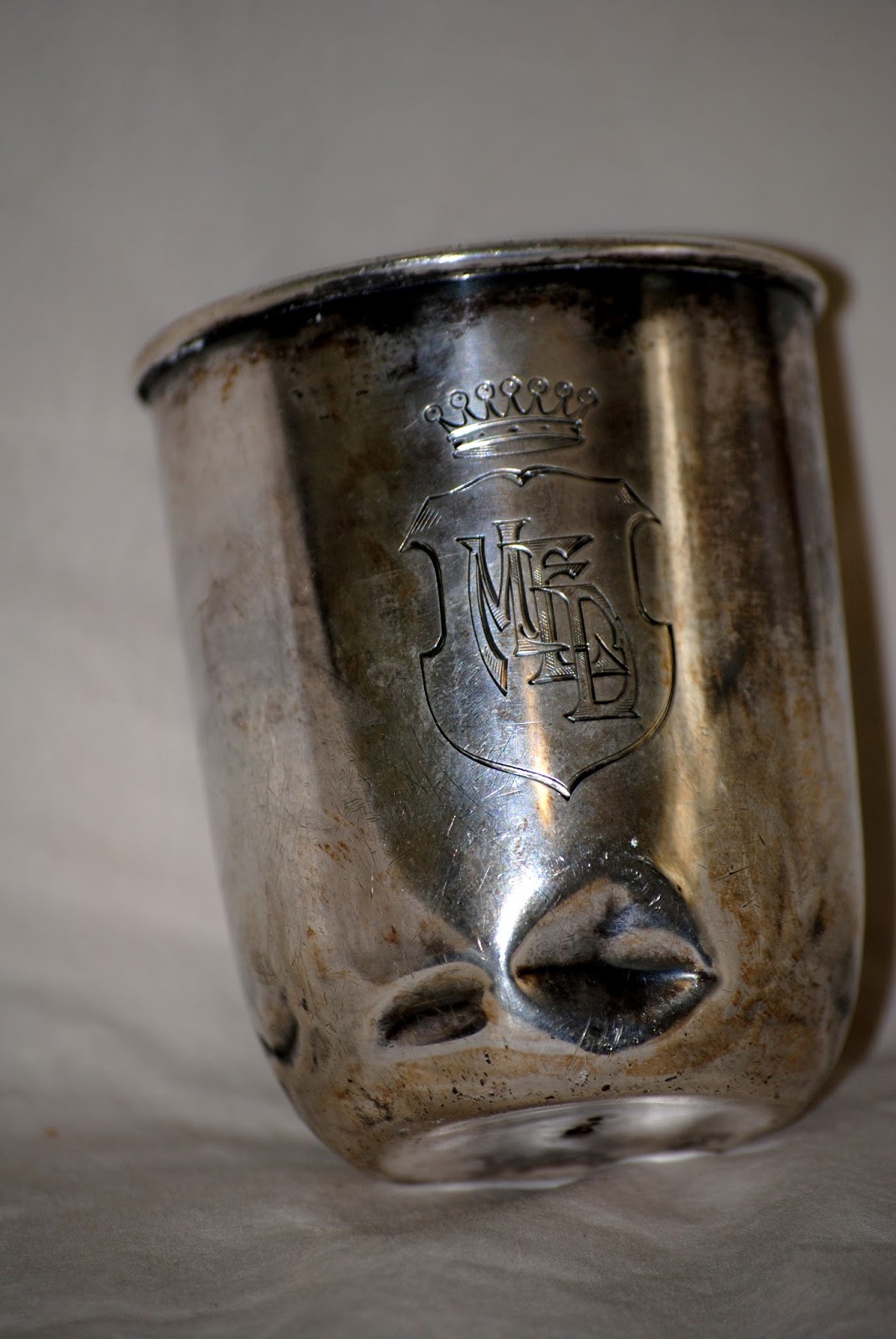 |
| I think this cup should go to my sister's first granddaughter |


The single most important piece to me is this pitcher. I was made in the mid 19th century and was originally a piece of von Grünewaldt silver. In about 1864 the family home was broken into and all the family silver was stolen but the robber was seen by my great grandmother Ebba. Her description helped the police find the robbers but all the silver other than this one piece were melted down.
At the end of World War 2 it was still in the possession of my great grandmother as she was transported by the Soviets to a labour camp in Siberia with her daughter Beate and granddaughter Sabine. Ebba died on the way to the labour camp and Beate shortly after arriving. Somehow Sabine managed to keep a hold of this pitcher through her 12 years in the labout camp. She says it is because it was so tarnished and beat up that no one thought it was silver. When she was released from the Soviet Union she managed to bring it out with her.
Sabine gave it to me for my baptism.
In 1994 our home in Vancouver was broken into and all CDs, thestereo equipment and some of Catherines jewelry had been stolen. I thought this pitcher had been stolen as well because it was missing. I told Sabine that I thought it had been stolen, she said that it would turn up. Some months later I found it when I went to clean out behind the fridge.


Thursday, April 10, 2014
Why the art of Peter von Tiesenhausen matters to me
 |
| The Ship |
I was first introduced to the start of Peter's art in the early 1970s. This introduction came at my parents dining room table in Tsawwassen. My mother was talking with my father about what he should give to his Godson Peter for Christmas and she insisted it should be a set of good quality oil paints. They ended up buying this for him at the Roof House Gallery in Point Roberts.
I first saw a painting by Peter around New Year's in the later 1970s. We were visiting the von Tiesenhausen's at their homestead in Demmitt Alberta. As a third cousin, Peter's father was my father's closest relative in North America. Peter showed my father a small landscape which looked like the Peace country in the late summer. My father smiled, which for him was great praise.
Demmitt Alberta and the whole Peace Country has a lot of similarities to the landscape my father grew up in Estonia. I never asked my father why we would often visit in the middle of the winter, but we did. I have to wonder if it was because for my father it was a chance to be back in the world of Schulmann family estate Limmat that he had to leave at age 17 in 1939. It may have been because the von Tiesenhausen's were creating farm from the wilderness in the 60s and 70s and my father liked to see the change over time.
Peter's early landscape I think spoke very deeply to the place that was the home of my father's soul.
For art to matter it has to have some sense of wonder, it has to make you think, it has to have an emotional connection for you, it has to matter to your soul. I have seen a lot of well known art. I learned how to look at an art work and try to connect and understand it. When I was at university I would often go to Vancouver on Tuesdays because this was the free admission day at the Vancouver Art Gallery. When I lived in London I went to the Tate Gallery more than any other place I can think of because of the art.
In an art gallery I try to sit quietly in a room for an hour or more and see what comes of it - almost a Quakerly Meeting for Worship type of process. I have really tried to understand and seek meaning or purpose in contemporary art but I found little genius. I rarely seen anything that spoke to my soul.
The galleries are sterile, they are about preserving the art works and celebrating the famous artists. I would look at a Rothko and could see that over time the painting had changed because of slow decay of the materials involved but that is not what the gallery wants. Paintings are cleaned, restored and otherwise conserved in a stasis. I started to pay more attention to the people in the galleries and saw that people came to "collect" the art, they walked through quickly and could then say they saw a Picasso or a Turner. The name of the dead artist and the fact they had seen the work of art mattered more to them than anything. They were soulless art spotters.
Over the years I had seen many paintings or sculptures that were beautiful but very few that pushed me to really think and contemplate, very few that touched my soul. Then one day I saw a sculpture that instantly spoke to me on a thousand levels or more.
In 1996 at the Lillooet Public Library I saw a picture of a sculpture in hay field. It was of a longboat made of branches from the woods around it. It was not at a gallery or in front of some corporate headquarters but in the field of a working farm. It was also weathered, it was clear to me the moment that I saw it had a finite lifespan and that nature would take it back. This sculpture would never be restored or conserved. The sculpture came from nature and would go back to nature. I then saw the name of the sculptor, Peter von Tiesenhausen, and I knew I had walked on this field as a child.

His work is not intellectual naval gazing that so many contemporary artists seem to want to do. Too often when I go into a gallery I see artists trying to "clever" or obscure in a way to exclude those that are not part of the "in crowd"and if you do not "get it" you are not part of the art club. There is no need to have an advanced degree in art history to see deep meaning and purpose in Peter's work. His work is not cynical or ironic, there is nothing jaded about it. It is not meaningless pretty or a clever graphic design. It is not created to shock for the sake of reaction and nothing else. His work is transcendent, honest, playful and deeply spiritual.
Peter's work is spiritual on the deepest level possible for art because it embraces that relationship between humans and the natural world at the most fundamental level. All spirituality comes from the need of every human society to make sense of the world around us. Peter's art speaks to the very core of this and how all human creations are ephemeral and are changed over time by the forces of the natural world around us.
 |
| Peter with Alex and one his charred figures |
 |
| Vessel/Enclosure at the Banff Centre |
Quaker's believe there is that of God in everyone and that your whole life is in someway part of your worship. Peter, while not being a Quaker, has done a brilliant job of showing how art, nature, everyday human activity, time and spirituality can all be part of a meaningful ongoing daily process of worship.
Peter's work matters to me so much because it has liberated me from the sterile world of the art gallery and opened my mind to a concept of art that is directly tied to my soul and the world I live in.